Snohomish County’s Flood Prep Skips One Risk: Your Sewer Line. A Sewer Backup Prevention Checklist
October 27th, 2026
Snohomish County Sewer News
Everett, WA · October 27, 2026
By The Drain Authority · Reviewed by Shane Caldwell, Owner & Lead Drain Technician · WA Contractor Reg. #DRAINDA756MA
Snohomish County rolled out its flood-season resources Monday, and county officials told The Herald on Tuesday that an El Niño winter is no reason to skip preparing. The county’s list covers rivers, roads, public drains and culverts. It doesn’t cover the one pipe that can put sewage on your basement floor during a storm: the sewer line between your house and the main, which homeowners generally own.
The short answer
How do you prevent a sewer backup in flood season?
Find and cap your cleanout, have an older or tree-adjacent line camera-inspected, clean out roots and buildup before the storms, keep grease and wipes out of the drains, and ask a licensed plumber whether a backwater valve makes sense for your lowest fixtures. Public drains and culverts are the county’s; the sewer line from your house is yours.
36,000 ac
Snohomish County land underwater at the Dec. 2025 flood peak
800+
People told to evacuate
52
Roads closed
$18M
Damage to public infrastructure, plus $5.5M reported by residents and businesses
What the county announced
In an October 26 release, Snohomish County said the NWS winter outlook for December 2026 through February 2027 points to an El Niño winter and urged residents to start planning now. The release lists tools from Emergency Management, Conservation and Natural Resources, the Health Department, Planning and Development Services and Public Works, including the Snohomish County Hazard Viewer, SnoCoAlerts, the Real-Time Flood Information System and a Drainage Investigation Request form.
The Herald’s Tuesday report adds the context: last December’s record flooding put 36,000 acres, or 56 square miles, of the county underwater at its peak. More than 800 people were told to evacuate, 52 roads closed, residents and businesses reported more than $5.5 million in damage, and public infrastructure took $18 million.
“We have very flashy rivers here.”
Lucia Schmit, Snohomish County Emergency Management director, to The Herald
Two readings of the same El Niño
The county’s release says this winter “likely will favor warmer temperatures and rain.” The NWS meteorologist The Herald interviewed, Maddie Kristell, framed it differently: El Niño tends to push the storm track toward the southern U.S., atmospheric rivers aren’t in this winter’s forecast, and El Niño precipitation is generally milder. Both agree on the wildcard. Warm storms that melt Cascade snowpack can still drive floods, and NWS can usually see heavy rain coming 3 to 8 days out.
For a sewer line, either reading lands in the same place. Warm storms fall as rain, rain saturates the ground, and saturated ground pushes water into any crack or loose joint in an older line.
The angle the flood checklists skip: the sewer line is yours
Flood guides focus on rivers, sandbags and evacuation routes, and they should. Sewer backup prevention rarely makes the list. But for many homes in Lynnwood, Edmonds, Mountlake Terrace and Bothell, the storm-season mess isn’t river water. It’s sewage at the lowest drain in the house.
The county’s list points residents to road maintenance for clogged public drains and culverts. The private sewer line is a different pipe with a different owner. Cities across the region say the same thing in plain terms: Bellevue Utilities says “homeowners are responsible for issues that occur in their sewer pipes,” and SPU says Seattle owners own their side sewer all the way to the public main.
Storm water finds its way into those lines. King County says groundwater seeps into sewer pipes through holes, cracks and joint failures, and that in some older Seattle neighborhoods roof drains and foundation drains flow straight into the sewer. Everett runs a backwater prevention device rebate program aimed at reducing sewer backups and basement flooding during heavy rain in its combined sewer area.
Why sewer backup prevention starts with what drains into the line
When a roof or foundation drain is tied into a sewer line, every inch of rain adds to what that pipe has to carry. USGS puts one inch of rain on one acre at about 27,154 gallons, or roughly 0.62 gallons per square foot:
Water from 1 inch of rain, by surface area
Gallons, at USGS’s 27,154 gallons per acre-inch. Any of it tied into a sewer lateral competes with your toilets and drains.
1,000 sq ftabout 620 gal
1,500 sq ftabout 935 gal
2,000 sq ftabout 1,250 gal
2,500 sq ftabout 1,560 gal
Source: USGS Water Science School. Figures rounded.
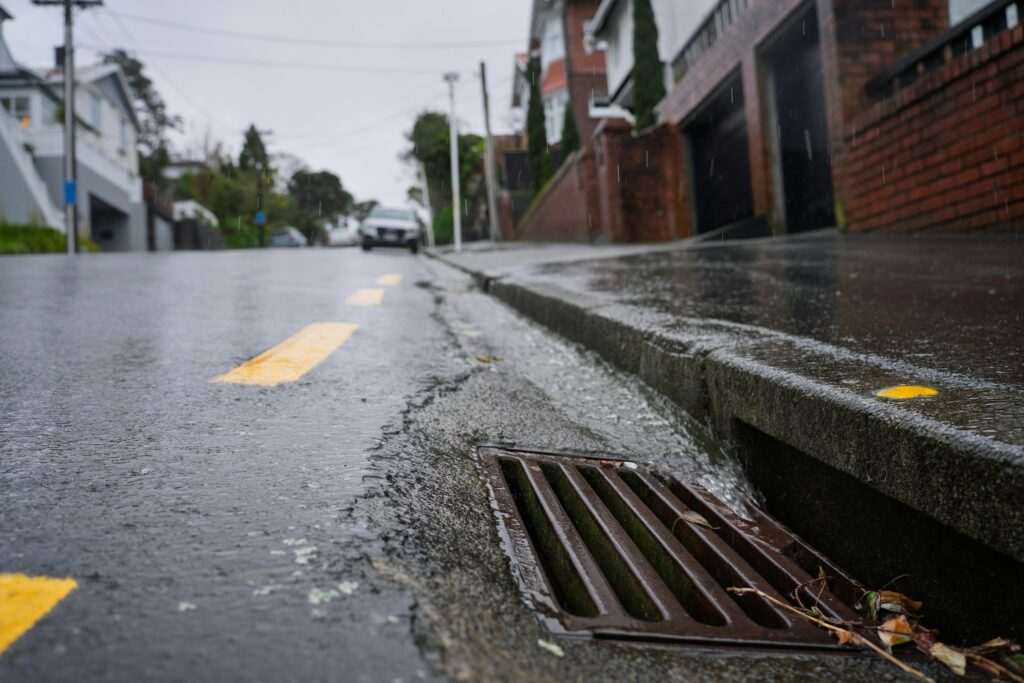
Storm water heads for the nearest drain. Any of it that reaches a sewer line through a crack or connected drain competes with the house for pipe space. Photo: Unsplash.
Sewer backup prevention checklist for Snohomish County homes
01
Find your cleanout and check the cap
It’s usually a capped pipe near the foundation or in the yard. A missing or cracked cap lets surface water straight into the line.
Bellevue Utilities notes the drains connecting a home to the main sewer are only about four inches wide. Wipes, grease and food scraps are the usual culprits.
05
Ask a plumber about a backwater valve
A backwater valve is installed by a licensed plumber, and SPU says owners who have one are responsible for maintaining it. A clean, inspected line is the starting point either way.
The Drain Authority’s published 2026 Seattle ranges for standard business-hour service. Access, line length, pipe condition and after-hours timing move the number. Diagnosis trip: $0.
What did Snohomish County release for flood season 2026?
On October 26, 2026, Snohomish County released flood-season resources from several departments, including the Snohomish County Hazard Viewer, SnoCoAlerts sign-ups, the Real-Time Flood Information System, an annual Flood Safety Guide, a Drainage Investigation Request form, and a road maintenance line for clogged drains or culverts at 425-388-7500.
Who do I call for a clogged drain or culvert in Snohomish County?
Snohomish County Public Works says to call road maintenance at 425-388-7500, Monday through Friday from 8:30 a.m. to 5 p.m., and to call 911 for emergencies or flooding outside those hours. Sewage backing up inside a home is a private sewer line problem, which goes to a drain cleaning or sewer service.
How do I prevent a sewer backup during flood season?
Know where your cleanout is and keep the cap on, have the line camera-inspected if it is older or near trees, clean out roots and buildup before the storms, keep grease and wipes out of drains, and ask a licensed plumber whether a backwater valve fits your home. SPU says a homeowner who has a backwater valve is responsible for maintaining it.
Does El Niño mean less flooding in Snohomish County this winter?
Not necessarily. County Emergency Management director Lucia Schmit told The Herald it is still worth preparing, and an NWS meteorologist said warmer storms that melt snowpack could add to flood risk even though atmospheric rivers are not in this winter’s forecast.
How much water does an inch of rain put on a roof?
USGS says one inch of rain on one acre equals about 27,154 gallons, or about 0.62 gallons per square foot. On a 2,000 square foot roof that is roughly 1,250 gallons, which matters when roof or foundation drains are tied into a sewer line, as King County says happens in some older Seattle neighborhoods.
The Drain Authority is a drain cleaning, sewer camera inspection and hydro jetting company serving King and Snohomish counties from Ballard. Photos via Unsplash as credited. Snohomish County Public Works contact details as published October 26, 2026.