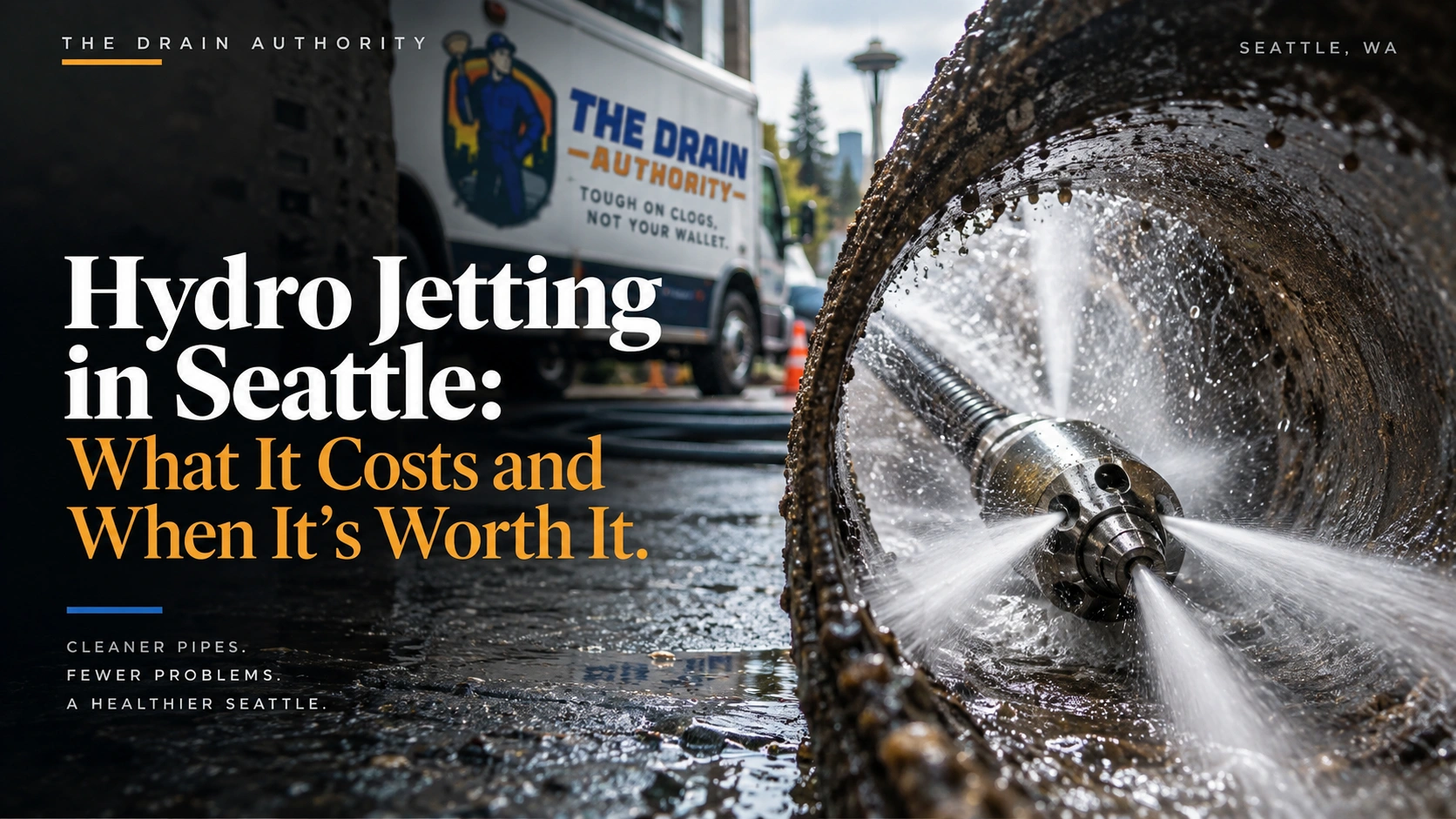
Drain Jetting in Seattle: What It Costs and When It Works
September 3rd, 2026
Seattle Hydro Jetting Guide
Written by the field crew at The Drain Authority, Seattle WA | Reviewed by Shane Caldwell, Owner | Updated September 3, 2026
The short answer
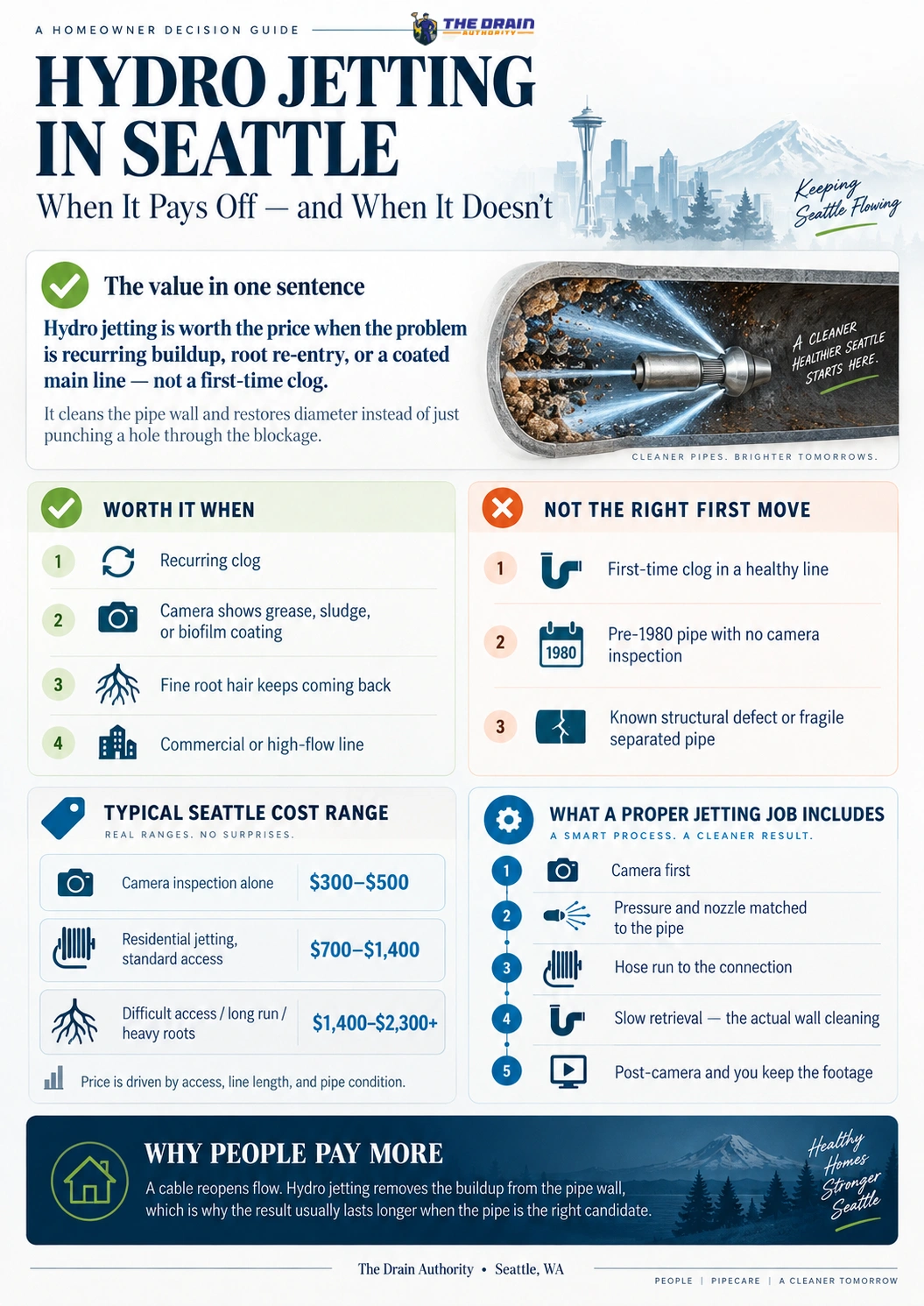
Hydro jetting is worth it when the same line has clogged more than once, when a camera shows the pipe wall is coated rather than blocked by a single object, or when roots have re-entered a joint. In Seattle it runs $700 to $2,300 depending on line length, access and pipe condition.
It is not worth it, and can be actively harmful, on a first-time clog in a healthy line or on deteriorated pre-1980 pipe that has never been inspected. Pressure finds the weakest point in a sewer. On any Seattle line installed before 1980, the camera goes first — not as an upsell, as a precondition.
Most articles about hydro jetting are written to sell hydro jetting. This one is written by the people who own the machine, and the honest position is that we turn it down regularly — because on the wrong pipe a jetter does not clean a sewer, it opens one.
What follows is the whole decision on hydro jetting in Seattle: how the equipment actually works, the four conditions that justify the cost, the three that rule it out, what it runs in the Seattle metro, and what a complete job includes so you can tell whether you were sold one. If you already know jetting is what you need, the Seattle hydro jetting service page has equipment detail and scheduling.
Tell us what the drain is doing and we will tell you whether jetting is the right tool — before we quote it. No trip fees, same-day across the Seattle metro.
Hydro jetting — also sold as drain jetting, hydrojet drain cleaning, or sewer line jetting — drives water through a hose to a nozzle with jets angled backward. Those rear jets do two jobs at once. Their thrust pulls the hose forward up the line, and their spray strikes the pipe wall behind the nozzle.
The cleaning happens on the way back. Once the nozzle reaches the far end, the operator draws the hose out slowly, and the rearward spray strips the full circumference as it travels — grease, sludge, biofilm, fine root hair, sediment shelves. What returns is not a channel through the blockage. It is the pipe’s original interior diameter.
Equipment, in plain terms
PRESSURE
Residential work typically runs 1,500–4,000 PSI. The number is set to the pipe, not to the machine’s ceiling.
FLOW
Gallons per minute carry debris out. On a main line, flow matters as much as pressure — high PSI with low flow cuts without flushing.
NOZZLE
Different heads for grease, roots, sediment and descaling. Head choice is the part homeowners never see and the part that decides the result.
ACCESS
An exterior cleanout is the difference between a straightforward job and pulling a toilet. It moves the price before work starts.
This is the difference between clearing and cleaning, and it is the single most useful distinction a homeowner can hold onto. A cable machine clears — it bores a channel and leaves the wall coated. A jetter cleans. We cover the full comparison in drain clearing vs. drain cleaning.
Is Hydro Jetting Worth It? Four Conditions That Say Yes
Jetting costs roughly two to three times a cable visit. It earns that in four situations and almost nowhere else.
1. The same line has clogged twice or more
Recurrence is diagnostic. A line that closes on a schedule has a cause that cabling is not reaching. Paying for a third clearing is paying to postpone the same conversation.
2. The camera shows a coating, not an object
Grease, sludge and biofilm reduce diameter along the whole run. A cable punches through and leaves the rest. This is the textbook jetting case, and it is why the camera inspection comes first.
3. Fine root hair has re-entered a joint
A cutting head trims a root mass; jetting flushes the remaining hair out of the pipe rather than leaving it to catch the next thing downstream. Neither is permanent while the entry point remains — see tree root drain clogs in Seattle.
4. Commercial flow volume never lets buildup rest
Restaurants, multi-family, anywhere fats and oils enter continuously. Here jetting is not a repair, it is an interval — details under commercial drain cleaning.
Three Conditions Where Jetting Is the Wrong Call
This is the part most jetting pages leave out. Turning the job down is sometimes the correct recommendation.
DO NOT JET
A first-time clog in a healthy line. One fixture, no history, sound pipe. A cable resolves it for a third of the money. Anyone leading with a jetter here is selling the machine, not solving the problem.
Pipe with cracks, separated joints or advanced deterioration. Pressure finds the weakest point. On a settled clay joint that is already open, jetting widens it. The failure is not gradual.
Tuberculated cast iron. Water will not remove hardened rust nodules. Repeat jetting on a scaled cast iron line produces weeks of improvement and no permanent change. That pipe needs mechanical descaling, often as the step before lining.
The safeguard for all three is the same and it is not complicated: on any Seattle line whose material and condition are unknown — which in practice means anything installed before 1980 — look inside before applying pressure. If a company proposes jetting a pre-war lateral without a camera pass, that is the answer to whether you should hire them.
Hydro Jetting Seattle Costs: What You Should Expect to Pay
Jetting is priced by access, line length and pipe condition — not by how bad the clog looks from inside the house. A main line with an accessible exterior cleanout and forty feet of run is a different job from a hundred-foot lateral reached by pulling a toilet.
Typical residential
$700–$1,400
Main line, accessible cleanout, standard run. Camera pass usually bundled.
Difficult access or long run
$1,400–$2,300
No exterior cleanout, heavy root mass, or a lateral running under a driveway or street.
Camera inspection alone
$300–$500
Standalone. Worth doing before you commit to jetting on any older line.
Observed Seattle metro ranges as of September 2026, standard business hours. Commercial and multi-family work is quoted separately. The Drain Authority charges no trip fee to diagnose, and the price is confirmed before work starts.
For context on where jetting sits against the other services: a single-fixture cable visit runs $300–$600 and main line cable cleaning $450–$900. Full breakdown of what moves each number is in the Seattle drain cleaning cost guide.
Ask before dispatch: “What is the total if you cannot reach it from the outside cleanout, and what is the total if you find roots?” A company that can answer both before sending a truck is quoting you. One that cannot is booking you. The mechanics of that are in the $99 drain cleaning problem.
What a Complete Jetting Job Looks Like
Five stages. If yours skipped stages one or five, you did not get a complete job — you got a jetter run down a pipe.
Stage 01
Camera first, on anything pre-1980
Establishes material, condition and whether pressure is safe at all. This is also where a defect gets found — a belly, an offset joint, a separated section — which changes the job from cleaning to repair before any money is spent on the wrong thing.
Stage 02
Access located and pressure set
An exterior cleanout where one exists. Pressure and nozzle are chosen against what the camera showed — a grease head, a root head and a sediment head behave differently, and running a machine at its ceiling because it is capable of it is how pipe gets damaged.
Stage 03
Hose run out to the connection
The nozzle travels to the far end of the run. In Seattle that means to the connection at the public main, because the side sewer is yours the whole way — under the parking strip, under the sidewalk, under the street.
Stage 04
Slow retrieval — the actual cleaning
Drawn back at a controlled rate so the rear jets strip the wall and flow carries debris out. Rushing this is the most common way a jetting job underdelivers: flow was restored, the wall was not cleaned, and the line reforms.
Stage 05
Post-camera, and you keep the footage
A second pass confirms the wall is actually clean and documents anything the buildup was hiding. You should leave with the recording, not a verbal summary. If a repair gets recommended later, that footage is your leverage when comparing bids.
When hydro jetting pays off, when it does not, what it costs in Seattle, and what a complete job includes. Source: The Drain Authority, Seattle WA, September 2026. Free to republish with attribution and a link to this page.
Camera pass, jetting, and the footage handed to you — quoted before work starts, no trip fee to look.
Four local conditions drive the jetting work in this city, and none of them appear in a national plumbing article.
The pipe is old, and it is yours
Roughly 43% of Seattle housing predates 1980 and around 10% predates 1940, which means vitrified clay with mortared joints and cast iron that has been corroding from the inside for sixty years. And the pipe from your building to the public main — the side sewer — is private property. Seattle Public Utilities states plainly that owners are responsible for it under Seattle Municipal Code Chapter 21.16, all the way to the connection, including the portion under the street.
Roots find joints, not cracks
Seattle’s street trees and mature private plantings are the most common cause of repeat main line failure we see, and the mechanism is widely misunderstood. Roots rarely break intact pipe. They locate an existing gap — usually a clay joint that has settled or a gasket that has failed — thread in as fine hair, then expand into a mass that catches everything arriving behind it. Jetting flushes the hair out; it does not close the gap. “We cut the roots last spring and they’re back” is a pipe-defect finding.
Wet season turns a restriction into a backup
A line carrying a sixty percent restriction moves household wastewater all summer without a single symptom. Then stormwater and rising groundwater start entering through roof drains, area drains, sump connections and gaps in the pipe itself, and the same line is suddenly moving volume it was never sized for. This is why our main line call volume is seasonal, and why a September camera pass is worth considerably more than a January emergency.
Flat runs and settled ground
Long, flat laterals let solids settle rather than carry, building sediment shelves that a cable rides straight over. On slopes it is the opposite problem — soil movement produces offsets and separated sections at the bottom of long runs. Washington adopts the Uniform Plumbing Code by reference in WAC 51-56, which governs the slope and support requirements that decide whether a run holds water in the first place.
One practical step before you book anything: Seattle keeps scanned side sewer cards — the original permit drawings filed when a property’s sewer was installed — searchable free by address through the Side Sewer Card Viewer. Five minutes there tells you install year, likely material, route, and whether the line is shared with a neighbour. All four change what jetting costs and whether it is appropriate. More on age-specific failure patterns in drain cleaning in older Seattle homes, and on shared laterals in the Ballard Side Sewer Report.
Where we jet
People search this as hydro jetting near me, but proximity is only half of it — what matters is whether the technician has opened lines like yours before. We run hydro jetting sewer line work in Ballard, Shoreline, Edmonds, Lynnwood, Bellevue and Kirkland, plus Redmond, Renton, Bothell, Kenmore, Woodinville, Mountlake Terrace and Lake Forest Park. Full coverage on the service areas page.
Commercial Jetting: An Interval, Not a Repair
For food service the question is not whether to jet, it is how often. Fats, oils and grease enter a commercial kitchen line continuously and congeal downstream where nobody can see them. Cabling a grease line is close to pointless — the channel closes within days. Quarterly jetting on kitchen mains is the interval that keeps a Seattle restaurant out of an emergency closure, and it is the documented preventive maintenance health inspectors expect to see rather than a record of reactive callouts.
There is a regulatory dimension too. Grease discharged to the sewer is governed under the EPA’s National Pretreatment Program, which is why interceptor maintenance and line cleaning are compliance items and not just housekeeping.
Multi-family is a different failure mode: a stack sized for one household now serving eight, and a tenant population that will flush wipes regardless of signage. Semi-annual main line service plus an annual camera pass on any pre-1980 building is the pattern that prevents the 2 a.m. call. Scheduling on the commercial drain cleaning page.
How to Tell a Real Jetting Company From a Machine Rental
Start with the state record rather than the reviews. Washington requires contractors to be registered, bonded and insured, and every record is public. Run the company through L&I’s Verify a Contractor tool before booking — active registration, active workers’ compensation, current bond, and any suits filed against that bond. It takes under a minute.
Then five questions that separate operators:
Will you camera the line before jetting it, and will I see the footage?
Is the jetter on your truck, or do you subcontract it?
What pressure will you run on my pipe, and how did you decide that?
What is the total if you cannot reach it from the outside cleanout?
What is your L&I registration number? (Then verify it yourself.)
Question three is the one that reveals the most. “Whatever it takes” is not an answer. A technician who has thought about your pipe will talk about material, age and what the camera showed.
Most homes never need a schedule — they need service when symptoms appear, and the right service when they do. Three situations justify an interval: a pre-1980 line with mature trees over the route benefits from annual main line attention; any property with a backup history should get a camera pass each autumn before the wet season; and food service generally needs quarterly jetting.
A workable rule: if you are plunging or buying drain products more than twice a year, the cause has not been addressed. And four habits genuinely reduce how often the jetter is needed — find your exterior cleanout before you need it, never flush wipes including the ones labelled flushable, cool and bin grease rather than washing it past the trap, and keep deep-rooted planting off the sewer route if you know where it runs. What is safe to attempt yourself is covered in professional drain cleaning vs. DIY in Seattle.
Find Out What Is Actually In Your Line
We camera first, quote second, and tell you when jetting is not the answer. No trip fees. Same-day service across the Seattle metro.
Open daily 8 AM to 8 PM | Licensed, bonded, insured | #DRAINDA756MA
Hydro Jetting FAQs
Is hydro jetting worth it?
Hydro jetting is worth it in four situations: the same line has clogged twice or more, a camera shows the pipe wall is coated with grease or sludge rather than blocked by an object, fine root hair has re-entered a joint, or the property is commercial where flow volume never lets buildup rest. It is not worth it on a first-time clog in a healthy line, where a cable machine resolves the problem for roughly a third of the cost. The deciding factor is pipe condition, not how severe the symptom feels.
How much does hydro jetting cost in Seattle?
Hydro jetting in the Seattle metro typically runs $700 to $1,400 for a residential main line with accessible cleanout access, and $1,400 to $2,300 or more where there is no exterior cleanout, a heavy root mass, or a long lateral running under a driveway or street. A standalone camera inspection runs $300 to $500 and is frequently bundled with jetting. Price is driven by access, line length and pipe condition rather than by the blockage itself.
Can hydro jetting damage old pipes?
Yes, if pressure is applied to pipe that cannot take it. Water pressure finds the weakest point in a line, and on a settled clay joint that has already separated, jetting widens it rather than cleaning it. Intact vitrified clay and sound cast iron generally jet safely at reduced pressure. The safeguard is a camera inspection before jetting any line whose material and condition are unknown, which in Seattle means essentially anything installed before 1980.
What is the difference between hydro jetting and snaking?
Snaking uses a rotating steel cable to bore a channel through a blockage and restore flow, leaving the pipe wall as it was. Hydro jetting uses high-pressure water with rear-facing jets to strip buildup off the wall itself, returning the pipe to its original interior diameter. Snaking is clearing; jetting is cleaning. That distinction explains most repeat service calls, because a cleared line still carries whatever caused the blockage.
What PSI is used for residential hydro jetting?
Residential work typically runs between 1,500 and 4,000 PSI, with the figure set against pipe material and condition rather than the machine’s maximum. Flow rate matters alongside pressure: gallons per minute is what carries loosened debris out of the line, so high pressure with low flow cuts without flushing. A technician who cannot explain why they chose a particular pressure for your pipe has not assessed it.
Does hydro jetting remove tree roots permanently?
No. Jetting flushes root hair and debris out of the line and restores flow, but roots enter through an existing defect such as a settled clay joint or a failed gasket, and that opening remains. Roots returning within a season indicate a structural defect rather than a maintenance gap. A camera inspection after clearing locates the entry point and determines whether the answer is scheduled maintenance, a spot repair, or lining.
How long does hydro jetting take?
A residential main line with accessible cleanout access is typically one to two hours including the camera passes before and after. Jobs without an exterior cleanout, with long runs, or with heavy root mass take longer. The retrieval stage should not be rushed: drawing the hose back slowly is where the wall actually gets cleaned, and hurrying it is the most common reason a jetting job underdelivers.
Should I get a camera inspection before hydro jetting?
On any Seattle line installed before 1980, yes, without exception. The camera establishes material and condition so pressure can be matched safely, and it distinguishes a blockage that jetting fixes from a pipe defect that jetting would worsen. It also finds what the buildup was hiding. Any company proposing to jet an older line without looking inside first is applying pressure to a pipe nobody has assessed.
How often should hydro jetting be done?
Most Seattle homes need jetting only when symptoms and a camera justify it, not on a schedule. Three cases warrant an interval: pre-1980 lines with mature trees over the route benefit from annual main line service, properties with a backup history should be inspected each autumn before the wet season, and food service businesses generally need quarterly jetting on kitchen mains. If you are plunging or buying drain products more than twice a year, the underlying cause has not been addressed.
Does the city of Seattle clean my sewer line?
No. In Seattle the side sewer running from your building to the public mainline is privately owned, including the portion beneath the parking strip, sidewalk and street. Seattle Public Utilities is responsible only from the mainline connection onward. If your side sewer joins a neighbour’s before reaching the main, responsibility for that shared segment is split between the properties. SPU does ask residents to report active backups at (206) 386-1800 so the city can rule out a public-side issue first.
Pressure ranges, method guidance and pricing reflect The Drain Authority’s observed Seattle metro practice as of September 2026 and are provided for planning purposes. Conditions on site determine the correct method and final cost. The Drain Authority is licensed, bonded and insured in Washington State, contractor registration #DRAINDA756MA.