Seattle Got 18% of Its Normal October Rain. Why Sewer Backups Follow the First Big Storms
October 28th, 2026
Seattle Sewer & Utility News
Seattle, WA · October 28, 2026
By The Drain Authority · Reviewed by Shane Caldwell, Owner & Lead Drain Technician · WA Contractor Reg. #DRAINDA756MA
Sea-Tac has recorded 0.62 inches of rain this October, against a normal of 3.40 inches by this date, according to the National Weather Service’s Seattle climate report Wednesday evening. That’s about 18% of normal. The wet season is late, not cancelled, and the way a sewer line behaves after a long dry stretch is why the first real storms tend to bring the backup calls.
The short answer
Why do sewer backups follow a dry spell?
During dry months, roots keep working into cracked and loose joints looking for moisture, and grease and debris settle in slow-moving lines. When heavy rain arrives, SPU says stormwater and groundwater get into sewers through cracks and connected drains, and any blockage already in your side sewer raises the odds that water comes back up your lowest drain. A camera check and cleaning before the storms is cheaper than the cleanup after.
0.62 in
Sea-Tac rain, Oct. 1 to 5 p.m. Oct. 28
3.40 in
Normal for that same stretch (1991 to 2020)
18%
Share of normal October rain so far
−4.59 in
Year-to-date shortfall since Jan. 1
The numbers behind the dry October
The NWS Seattle daily climate report issued at 6:16 p.m. Wednesday puts Sea-Tac at 0.62 inches for the month, 2.78 inches below normal. Since January 1 the airport has logged 22.21 inches against a normal 26.80. Wednesday itself brought a tenth of an inch of rain, fog and gusts to 31 mph.
Sea-Tac rainfall vs. normal
Inches of rain, observed against the 1991 to 2020 normal for the same dates.
October 2026 to date (observed)0.62 in
October normal to date3.40 in
Jan. 1 to Oct. 28, 2026 (observed)22.21 in
Jan. 1 to Oct. 28 normal26.80 in
Source: National Weather Service Seattle, Climate Report for Seattle-Tacoma Airport, Oct. 28, 2026 (valid as of 5 p.m.). Each pair is scaled to its own normal.
What a dry fall does inside a sewer line
A side sewer doesn’t care what month it is. It cares about water, and a dry spell changes where the water is.
Roots go looking. The City of Traverse City’s sewer utility puts it plainly: “During drought conditions and in winter, tree roots travel long distances in search of moisture.” Warm water vapor escaping through a cracked joint is what leads them in. SPU says roots are a common problem in older concrete and clay side sewers that weren’t built with watertight joints.
Roots only use openings that already exist. An N.C. Cooperative Extension urban forester notes that roots can’t create cracks in a sewer pipe; they exploit cracks and gaps that are already there, then widen them as they grow.
Low flow lets debris settle. SPU says sags and offset joints collect debris, and that grease can slow a side sewer or block it completely. A root mass catches whatever comes down the line.
Then the rain changes the load. SPU warns that “winter storms can overload the sewer system when excessive stormwater and groundwater enters sewer pipes” through cracks, gaps and connected drains, and that any blockage in your side sewer helps cause backups when it floods. King County says groundwater “seeps into sewer pipes through holes, cracks, and joint failures.”
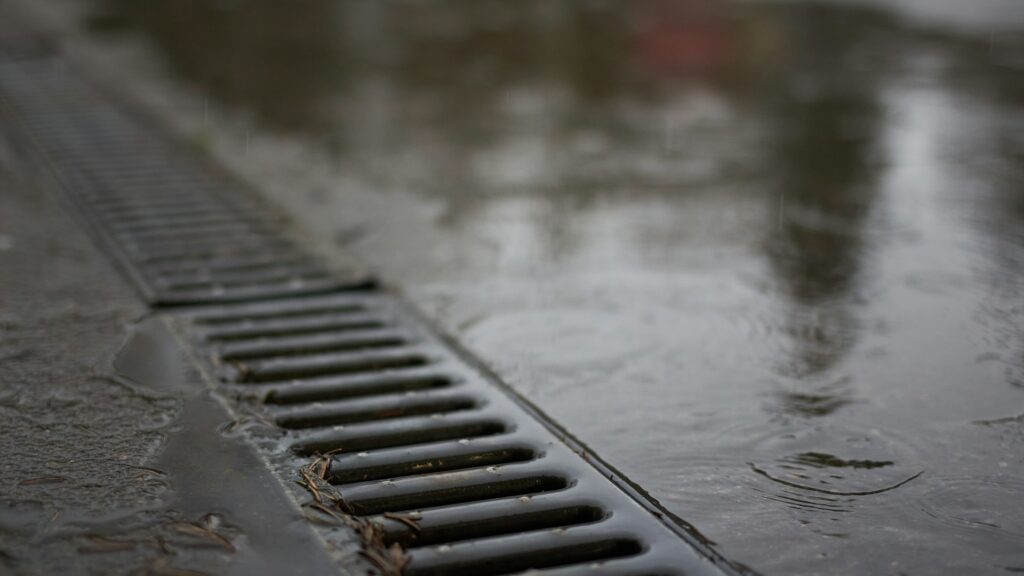
Rain returning to a Seattle street. After a dry stretch, the first sustained storms are when weak sewer lines show themselves. Photo: Josh Hild / Unsplash.
The angle most coverage misses: a dry October can hide a failing line
Most storm coverage looks up at rivers and roads. The backup that ruins a basement usually starts underground, in a pipe the homeowner owns. And a dry month is the worst time to learn anything about that pipe, because a partly blocked line can drain fine when it’s only carrying household water.
That’s the setup heading into November, Sea-Tac’s wettest month on the 1991 to 2020 normals at 6.31 inches. Roots that worked in during the dry stretch, plus grease or sludge they’ve caught, meet the first sustained rain and the groundwater that comes with it.
The fix is boring and well timed: look first, clean what’s there, and know where your cleanout is before you need it at 10 p.m. in a storm.
Does El Niño mean a dry winter? Not reliably.
NOAA’s winter outlook released October 15 favors warmer-than-average temperatures for the Pacific Northwest from December through February, and says a very strong El Niño tends to shift the jet stream south and east. That’s the case for a milder winter here.
The Washington State Climate Office adds the caution. It says this event has about a 95% chance of becoming very strong, that El Niño only slightly raises the odds of a drier Northwest winter, and that some of the strongest El Niños on record, 1982-83, 2015-16 and 1957-58, brought above-normal precipitation to the region. On average, El Niño and La Niña explain about 30% of the variation in winter circulation patterns.
The takeaway for your sewer line
A forecast that tilts warm doesn’t protect a cracked joint. Warmer storms bring rain instead of snow, and rain is what loads a sewer. Plan for normal wet-season storms either way.
Warning signs to check this week
What you notice
Likely cause
First step
Gurgling toilet when the washer drains
Partial blockage in the main line
Camera the side sewer
Water at the basement floor drain after laundry
Roots or debris near the cleanout or under the slab
Clear with a cable and root cutter, then camera
Several fixtures slow at once
Main line, not a single fixture
Main line cleaning
Same clog every few months
Roots or buildup coming back
Camera, then hydro jetting if the pipe is sound
Sewer smell in the yard
Possible break or failed joint
Camera to locate; repair referral if broken
Signs drawn from SPU and Traverse City guidance on root intrusion and slow drains.
Water pooling at a drain is the outdoor version of the floor drain that backs up first indoors: the lowest point shows the problem. Photo: Ilya Semenov / Unsplash.
What to do before the next big storm
01
Find your cleanout
It’s usually a capped pipe near the foundation or in the yard. Make sure the cap is on and reachable. If you can’t find it, your side sewer card can help.
02
Camera the line if trees are close
SPU recommends a scope every 2 to 3 years when large trees or shrubs grow near the side sewer. A sewer camera inspection shows whether it’s roots, buildup or a break.
03
Clean based on what the camera shows
Roots usually come out with a cable machine and cutting head through rooter service. Grease, sludge and fine root hair on the pipe walls are what hydro jetting is for.
04
Keep grease and wipes out
SPU says to flush only toilet paper and to keep cooking oil and grease out of drains. Grease is what turns a root mass into a plug.
05
Don’t wait for the second backup
If water came up a floor drain once, it’s telling you where the line is weak. Main sewer line cleaning before the storm is a scheduled visit; after, it’s an emergency.
Service
Seattle price range
Best for
Sewer camera inspection
$300 to $500
Finding roots, buildup, sags or breaks
Main line cable cleaning
$450 to $900
Root clogs and blockages
Hydro jetting (typical residential)
$700 to $1,400
Grease, sludge and root hair on pipe walls
The Drain Authority’s published 2026 Seattle ranges for standard business-hour service. Access, line length, pipe condition and after-hours timing move the number. Diagnosis trip: $0.
The National Weather Service’s Seattle climate report for October 28, 2026 shows 0.62 inches at Sea-Tac for the month as of 5 p.m., against a normal of 3.40 inches to that date. That is about 18% of normal, 2.78 inches below.
Why do sewer backups happen when heavy rain finally arrives?
SPU says winter storms can overload the sewer system when stormwater and groundwater get into sewer pipes through cracks, gaps and connected drains, and that any blockage in your side sewer adds to the risk of a backup when it floods. King County says groundwater seeps into sewer pipes through holes, cracks and joint failures.
Do tree roots grow into sewer pipes during dry weather?
Roots seek moisture. The City of Traverse City’s sewer utility says that during drought and in winter, tree roots travel long distances in search of moisture, following water vapor to cracks and loose joints in sewer pipes. SPU says roots are attracted to the water and nutrients in the sewer and are a common problem in older clay and concrete side sewers.
Will El Niño make this a dry winter in Seattle?
Not necessarily. The Washington State Climate Office says El Niño slightly raises the odds of a drier Pacific Northwest winter, but that relationship is weak, and some of the strongest El Niños on record, including 1982-83, 2015-16 and 1957-58, brought above-normal precipitation to the region.
Should I snake or hydro jet my sewer line before winter?
It depends on what is in the pipe. A camera inspection comes first. Roots are usually cut with a cable machine and root cutter, and hydro jetting is used to clean grease, sludge and fine root hair from the pipe walls. The Drain Authority’s published Seattle ranges are $450 to $900 for main line cable cleaning and $700 to $1,400 for typical residential jetting.
The Drain Authority is a drain cleaning, sewer camera inspection and hydro jetting company serving King and Snohomish counties from Ballard. Photos via Unsplash as credited.