Hydro Jetting vs. Snaking: Which One Does Your Drain Need?
June 21st, 2026
Drain Cleaning · Methods
Updated October 26, 2026
By The Drain Authority · Reviewed by Shane Caldwell, Owner & Lead Drain Technician · WA Contractor Reg. #DRAINDA756MA
Snaking and hydro jetting both get water moving again, so it’s easy to assume the cheaper one is the smart choice. Sometimes it is. But they solve different problems, and picking the wrong one is how a $400 visit turns into three $400 visits, or how a $1,000 jetting job goes into a pipe that needed a camera first.
The short answer
Is hydro jetting better than snaking?
It depends on what’s in the pipe. Snaking pushes a cable through the line and bores a channel through a blockage. It’s the right call for a single clog at one fixture and runs $300 to $600 in Seattle. Hydro jetting scours the full pipe wall with high-pressure water, removing grease, roots and scale. That makes it the better choice for recurring clogs and main line buildup, at $700 to $2,300 or more. On older or uninspected lines, a camera inspection ($300 to $500) should come first.
$300–$600
Snaking one drain, Seattle range
$700–$2,300+
Hydro jetting, Seattle range
1,500–4,000
Typical residential jetting PSI, set to the pipe
Camera first
On any older or uninspected line
Hydro jetting vs. snaking, side by side
Snaking (cable / auger)
Hydro jetting
How it works
A rotating steel cable with a cutting head bores through the blockage
A nozzle with rear-facing jets pulls the hose up the line and scrubs the pipe wall on the way back
What it leaves behind
Grease, scale and fine roots still coating the wall
The pipe’s original interior diameter
Best for
One slow or stopped fixture; hair, wipes, a soft first-time clog
Grease lines, root intrusion, scale, recurring main line clogs
Not for
Lines that keep re-clogging from buildup
Cracked, collapsed or uninspected pipe; a simple one-fixture clog
Seattle cost range
$300–$600 one drain $450–$900 main line
$700–$1,400 typical residential $1,400–$2,300 hard access or long run
Older pipe
Gentler, but can catch on offsets and leave a hole through the buildup
Safe on sound pipe when pressure and nozzle are matched to it; camera first
Price ranges are The Drain Authority’s published 2026 Seattle ranges for standard business-hour service.
Put simply: a cable clears the line and a jetter cleans it. A cleared line flows today. A cleaned line has nothing left on the wall to catch the next clog. We go deeper on that distinction in drain clearing vs. drain cleaning.
Which one does your drain need?
What you’re seeing
Usually
Why
One bathroom sink or tub slow, everything else fine
Snake
A local clog, usually hair and soap, close to the fixture.
A toy, wipe or object flushed or dropped
Snake
A cable can grab or break up a single obstruction.
Kitchen sink clogs every few months
Jet
Grease is lining the pipe; a cable just reopens the channel.
Several fixtures slow, toilets gurgle, floor drain backs up
Camera, then decide
A main line problem. Find out whether it’s buildup, roots or damage.
Same main line clog weeks after it was snaked
Jet
Buildup left on the wall is closing the line again.
Roots found on a previous visit
Jet
Jetting clears roots back to the wall; a cable leaves material behind.
Older home, line never inspected, heavy backup
Camera, then decide
Pressure into a damaged pipe can make things worse. Look first.
Restaurant or apartment grease line
Jet
High-volume grease lines are usually jetted on a schedule.
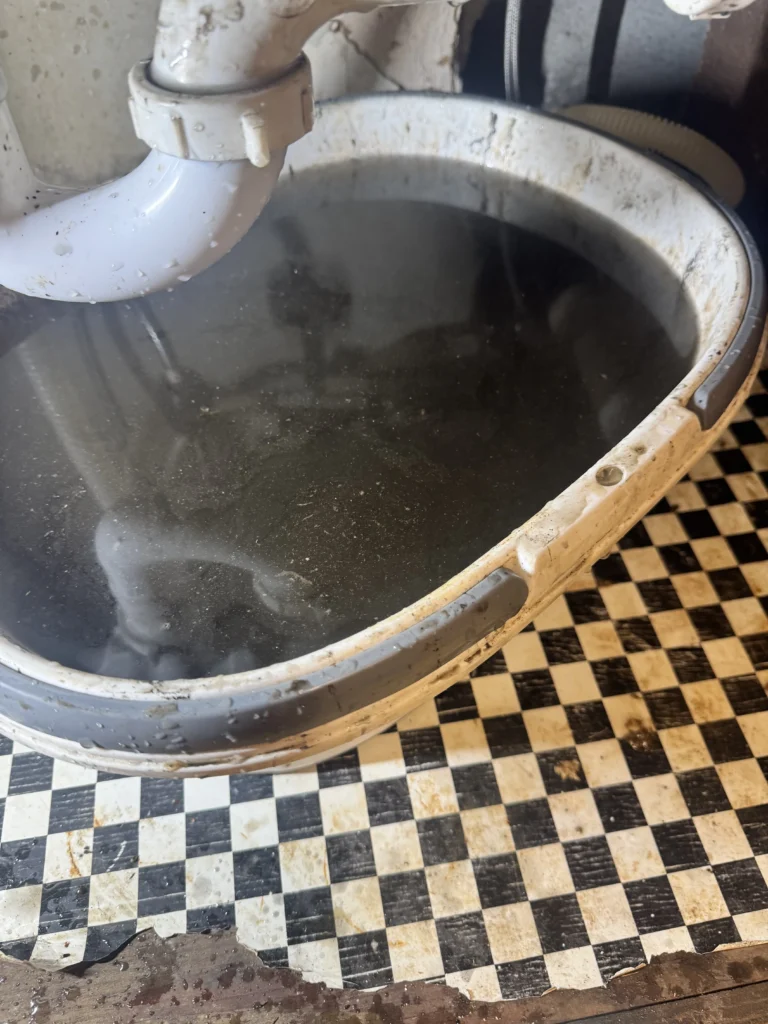
A backed-up sink on a Seattle-area service call. Standing water at one fixture can be a local clog, or the first sign of a main line problem.
Why a snake can work and still fail
A cable rarely fails to open a drain. The problem is what happens afterward. On a line coated with grease, the cable bores a hole through the middle, water flows, and everyone goes home. The coating stays. Food particles and soap catch on it, the channel narrows, and the drain backs up again weeks or months later.
Roots behave the same way. A cutting head can slice through a root mass and restore flow, but the fine root hair left on the wall regrows. Our guide to tree roots in Seattle sewer lines covers what that looks like on camera.
When hydro jetting is the wrong call
Jetting is not a better version of snaking for every job. It’s a different tool, and there are times we won’t use it:
A single soft clog at one fixture. A cable clears it in minutes. Jetting it is paying for capacity you don’t need.
A line nobody has looked at. On older pipe, the camera comes first. Cracks, separated joints and missing sections change the plan.
A collapsed section or a deep belly. Water sitting in a sag or a broken run needs repair, not cleaning.
Heavy scale in cast iron. Thick tuberculation often needs cast iron pipe descaling rather than jetting alone.
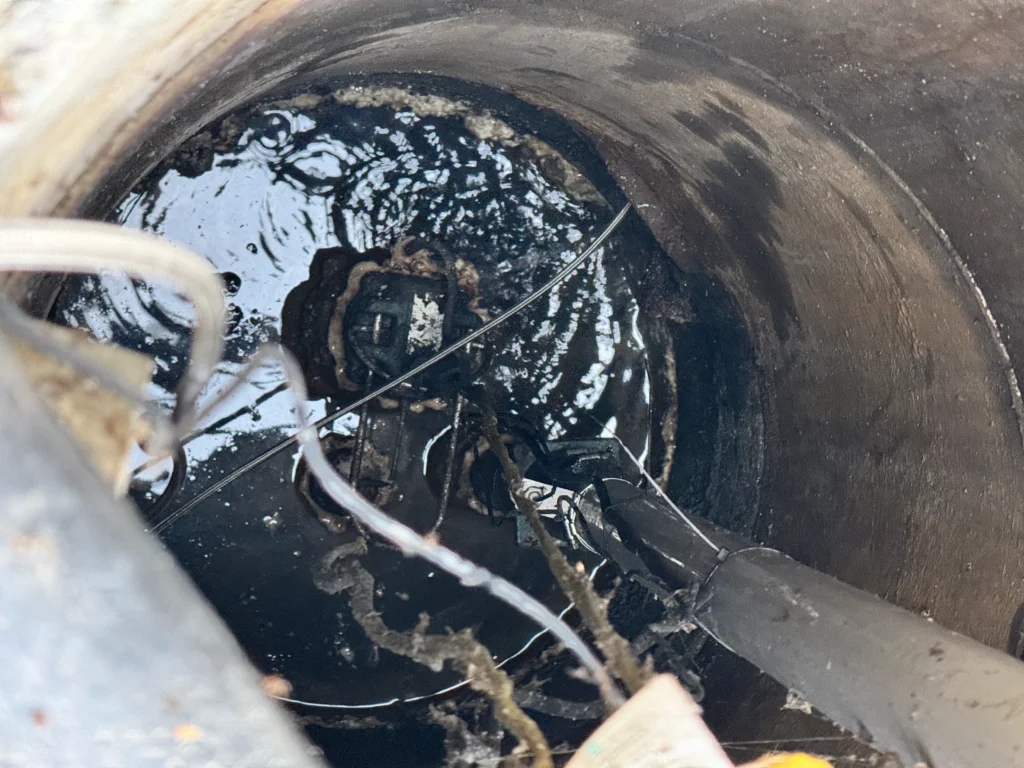
A jetting hose at work in a maintenance hole on a Seattle sewer line. Pressure and nozzle are chosen for the pipe, not the machine’s maximum.
The angle most comparisons miss: the cheaper visit isn’t always cheaper
Most comparisons stop at “snaking costs less.” Per visit, it does. But on a line that keeps clogging, the comparison that matters is total cost over the next year.
Using our published Seattle ranges: one main line cable cleaning runs $450 to $900. Two of them run $900 to $1,800, and three run $1,350 to $2,700. Typical residential jetting with an accessible cleanout runs $700 to $1,400. If the clog is coming from buildup on the pipe wall, the second cable visit is often where jetting would already have paid for itself.
The opposite mistake costs money too. Jetting a line with a broken section can push debris into the break or make a weak spot worse, and you still need the repair. That’s why the $300 to $500 camera inspection is the cheapest part of getting this decision right.
Seattle lines make this decision harder
Older Seattle homes add a few complications that make a camera look worth it before jetting:
Clay and cast iron side sewers that have been in the ground for decades, with joints that roots exploit.
Mature street and yard trees whose roots find those joints.
Not always. Snaking is the right call for a single clog at or near one fixture. Hydro jetting is better for grease, roots, scale and recurring main line clogs because it cleans the whole pipe wall instead of boring a channel through the blockage.
Is hydro jetting worth the extra cost?
It is when the same line keeps clogging. In The Drain Authority’s Seattle ranges, a main line cable cleaning runs $450 to $900 and typical residential jetting $700 to $1,400, so two or three repeat cable visits can cost as much as jetting the line once.
Can hydro jetting damage pipes?
It can if high pressure goes into a line that is already cracked, collapsed or badly deteriorated. That is why older lines should get a camera inspection first, and why residential jetting pressure, typically 1,500 to 4,000 PSI, is set to the pipe rather than the machine’s maximum.
How much do snaking and hydro jetting cost in Seattle?
In The Drain Authority’s published 2026 Seattle ranges, single-drain snaking runs $300 to $600, main line cable cleaning $450 to $900, hydro jetting $700 to $2,300 or more, and a sewer camera inspection $300 to $500.
Does snaking remove tree roots?
A cable with a cutting head can cut through roots and restore flow, but it tends to leave root material on the pipe wall. Jetting clears roots back to the pipe wall more completely. Neither one repairs the crack or joint the roots grew through.
Do grease clogs need hydro jetting?
Often, yes. Grease coats the inside of the pipe, so a cable usually opens a path through it and leaves the coating behind. Seattle Public Utilities notes that many cooking oils, like olive and coconut oil, harden in cooler pipes and cause blockages.
The Drain Authority is a drain and sewer specialist serving King and Snohomish counties from Ballard. Price ranges are The Drain Authority’s published 2026 Seattle ranges for standard business-hour service; access, line length, pipe condition and after-hours timing move the number. Photos are from Seattle-area service calls.