

Roughly half of Seattle’s housing stock was built before 1980, back when side sewers were laid in vitrified clay, cast iron, and tar-impregnated fiber. Those pipes leak at the joints. Roots find the leak. That is the whole story of tree root drain clogs in Seattle, and it is why snaking the line every eighteen months never ends the problem.
If your drains are slowing across the whole house, your toilet gurgles when the washing machine drains, or a clog you paid to clear came back inside two months, you are almost certainly dealing with root intrusion rather than a simple blockage. This guide covers how to confirm it, who is legally responsible for the pipe, what actually removes roots versus what just buys you a few weeks, and why cutting down the tree is rarely an option inside Seattle city limits.

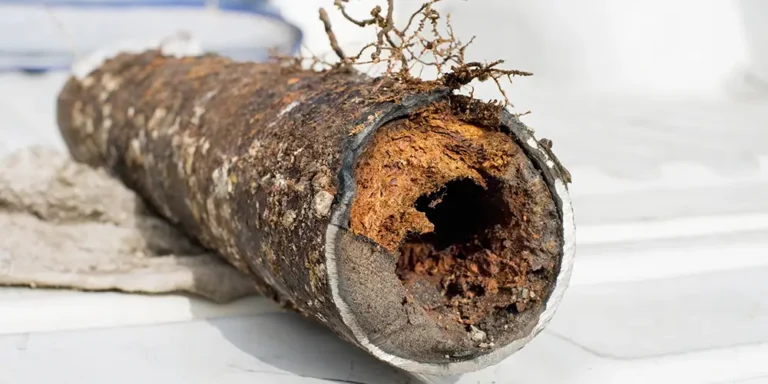
Roots do not attack healthy, sealed pipe. They grow toward moisture and oxygen, and a sound sewer lateral offers neither. What roots exploit is a joint that has shifted, a hairline crack, or a section of pipe that has softened. Every one of those defects is a function of what the pipe is made of and how long it has been in the ground.
Seattle’s housing stock tells you exactly how widespread that exposure is.
Figure 1 · Seattle housing units by construction era
203,763 Seattle homes were built before 1980
That is 49.5% of all 411,671 housing units in the city, and it maps almost exactly onto the era of clay, cast iron, and bituminized fiber side sewers.
Legacy pipe era (pre-1980)
Modern plastic pipe era (1980+)
Source: U.S. Census Bureau, American Community Survey 2024 1-Year Estimates, Table B25034 (Year Structure Built), Seattle city, Washington.
Note: construction year is a proxy, not proof. Some older homes have had laterals replaced; some newer homes sit on a reused legacy line. A camera is the only way to know what is actually under your yard.
The materials behind those numbers matter. Vitrified clay was laid in short sections with mortared or gasketed joints that open as soil settles. Cast iron corrodes from the inside out, roughening the wall and eventually perforating it. And bituminized fiber pipe, sold under the name Orangeburg, was installed across the country from the mid-1940s through the early 1970s: layers of wood pulp bound with coal tar pitch, marketed at a fifty-year service life. The American Public Works Association notes that Orangeburg was once believed to be root-proof, but as the tar dried, moisture penetrated the walls and roots followed. In Seattle, 116,725 housing units, 28.4% of the stock, fall inside that 1940 to 1979 construction range.
Old pipe alone is not enough. You also need a root source within reach of the lateral. Seattle’s neighborhood canopy data shows how unevenly that risk is distributed across the city.
Figure 2 · Tree canopy cover by Seattle neighborhood
Canopy cover ranges from 17.3% in Ballard to 50.6% in Broadview
Selected neighborhoods, measured as neighborhood canopy area divided by total neighborhood area. The dotted line marks the 28.6% citywide figure for the same assessment year.
Citywide reference: 28.6% canopy cover in the 2016 assessment; the City’s 2021 assessment put citywide cover at 28.1%, a loss of 255 acres.
Source: Seattle Urban Forestry Commission, Right of Way Tree Canopy Data briefing (June 2023), neighborhood figures derived from 2016 canopy cover data; City of Seattle Office of Sustainability & Environment, 2021 Tree Canopy Assessment.
Read this as a mature-tree density proxy, not a root-intrusion forecast. A single poplar twelve feet from a 1920s clay lateral in low-canopy Ballard will do more damage than a whole block of young street trees in a high-canopy neighborhood.
Put the two figures together and the pattern is clear. The highest-exposure properties in our service area are pre-1980 homes sitting under established canopy, which describes large parts of Wallingford, Ravenna, Wedgwood, Phinney Ridge, Green Lake, Madison Park, and much of north Ballard. If that is your house, root intrusion is not a question of whether but of when it was last checked. Our guide to drain cleaning in older Seattle homes goes deeper on what changes when the pipe is eighty years old.
Root intrusion announces itself in a specific order. Individual fixture problems point to a local clog. Problems that cross fixtures point to the main line. Use the table below to place what you are seeing and decide how fast you need to move.
| What you’re seeing | What it usually means | Urgency |
|---|---|---|
| Multiple drains slow at once Kitchen, bath and laundry together |
Restriction in the main line, not a fixture trap. Roots are the leading candidate in older homes. | Schedule this week |
| Toilet gurgles when another fixture drains | Air is being displaced past a partial blockage downstream of both fixtures. | Schedule this week |
| A cleared clog returns within 60 to 90 days | A cable punched a hole through the mass without removing it. The entry point is still open. | Schedule this week |
| Sewer odor near a floor drain, cleanout, or in the yard | Waste is sitting in the line longer than it should, or escaping through a crack into soil. | Schedule this week |
| A strip of lawn is greener or stays soggy in dry weather | The lateral is leaking and fertilizing the soil above it. The pipe is already compromised. | Schedule this week |
| Sewage backs up into a tub, shower, or floor drain | The main line is blocked and the lowest opening in the house has become the overflow point. | Call now |
| Toilet rises or overflows when the washer drains | A cross-fixture backup. Volume from one fixture has nowhere to go and is pushing back. | Call now |
Two or more of these at the same time takes a simple clog off the table. At that point the only question worth answering is what the inside of the pipe looks like, which means a sewer camera inspection in Seattle before anyone quotes you a repair.
Seattle Public Utilities is unambiguous on this point: the entire side sewer, all the way to the connection at the public main under the street, is owned and maintained by the property owner. Responsibility does not stop at your property line. It stops at the tee in the street.
This is the single most expensive thing Seattle homeowners misunderstand about root clogs. People assume the city handles anything past the sidewalk and delay repairs waiting for help that is not coming. Maintenance and repair of private side sewers within city limits is governed by Seattle Municipal Code Chapter 21.16, and SPU’s own side sewer guidance spells out where the boundary sits.
Three practical consequences follow.
Our published Ballard side sewer report walks through what these ownership rules look like in one specific neighborhood, including how age of construction lines up with recorded side sewer cards.
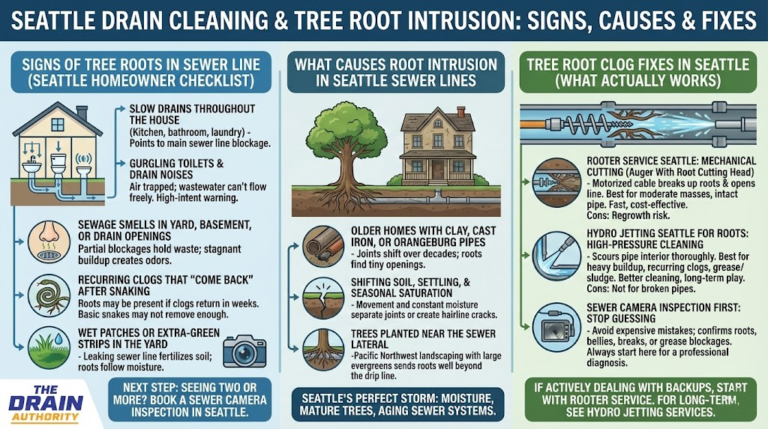
Four methods get used on root intrusion, and they are not interchangeable. Matching the method to the pipe condition is the entire difference between a fix that holds and a service call you repeat every spring.
| Method | Best for | Limitation | Typical repeat interval |
|---|---|---|---|
| Rooter / mechanical cutting Motorized cable, root-cutting head |
Restoring flow fast during an active backup. Moderate root mass in structurally sound pipe. | Cuts a channel through roots but leaves fine root hair anchored to the pipe wall. | Shortest of the four |
| Hydro jetting High-pressure water, wall-to-wall scour |
Recurring clogs, mixed root and grease buildup, restoring full pipe diameter rather than a channel. | Not appropriate on a collapsed, badly offset, or severely deteriorated line. Camera first, always. | Longer than cutting |
| Pipe descaling Chain knocker or rotating head |
Cast iron laterals where corrosion scale has narrowed the bore and given roots and debris something to catch on. | Material-specific. Wrong tool for clay or fiber pipe. | Multi-year when followed by jetting |
| Spot repair or lining Excavation or trenchless |
Closing the actual entry point: an offset joint, a crack, a deformed section of fiber pipe. | Requires a permit, and a camera-verified diagnosis to justify the scope. | Permanent for the repaired section |
The honest version of this is simple. Cutting buys you time. Jetting buys you more time. Only repair removes the reason roots are there. A contractor who recommends the same method regardless of what the camera shows is selling a service, not solving a problem, which is the same pattern we documented in the $99 drain cleaning scam in Seattle.
When sewage is coming up through a shower drain, the priority is flow, not diagnosis. A cable with a root-cutting head opens the line quickly and stops the damage. That is what rooter service in Seattle is for, and it is the correct call in an emergency. The mistake is treating it as the end of the job. Once flow is restored, the pipe still has an opening in it and the root system still knows where the moisture is.
Jetting uses pressurized water to scour the pipe wall rather than bore through the obstruction. On a line that has been cabled several times, the difference is usually visible on camera: cutting leaves a passage, jetting leaves a pipe. For laterals carrying both root intrusion and years of grease, it is the method that resets the line. Our Seattle hydro jetting service page covers the equipment and process, and our analysis of when jetting is worth it versus overkill covers the cases where it is not the right answer.
A root mass and a collapsed section of Orangeburg produce nearly identical symptoms from inside the house. They require completely different work and differ by an order of magnitude in cost. A camera run settles it in under an hour, identifies the entry point by distance from the cleanout, and gives you footage to compare against any bid you receive. It is the cheapest step in the entire process and the only one that makes the others accountable. If you take one thing from this guide, make it this: never authorize a repair you have not seen on video.
These four findings move a job out of the cleaning category and into the repair category. Any one of them means cleaning alone will not hold.
Roots return within weeks of a thorough clearing
A properly cleaned line should not re-clog in a season. When it does, the entry point is large enough that the root system is regrowing into open pipe continuously.
The camera shows an offset joint or visible crack
Misaligned sections do not realign. Every cleaning cycle from this point forward is maintenance on a known defect, which is a reasonable choice only if you make it deliberately.
There is a belly holding standing water
A low spot collects solids continuously. Roots growing into a belly compound a problem that cleaning cannot correct, because the sag is a grade issue, not a blockage.
The pipe is deformed fiber or heavily corroded iron
Bituminized fiber pipe ovals before it collapses. Once the wall has lost shape, no cleaning method restores it, and aggressive cleaning can accelerate failure.
For system-level work beyond drain and sewer cleaning, see our advanced plumbing services in Seattle. For the reasoning behind bringing in a drain specialist rather than a general plumber on a root job, we covered that in why hiring a drain cleaner can save you thousands.
This is the first question most homeowners ask once a camera confirms roots, and the answer inside Seattle city limits has changed significantly. The 2023 update to the city’s Tree Protection Code replaced the old “exceptional” and “significant” designations with a four-tier system, and removal of trees in any tier is generally prohibited on developed property where no development is proposed.
| Tier | Roughly what it covers | What that means for you |
|---|---|---|
| Tier 1 | Heritage trees designated through the City’s Heritage Tree Program. | Highest protection. Removal is limited to narrow circumstances including documented conflict with infrastructure. |
| Tier 2 | Most trees at 24 inches DSH or larger, plus species designated by Director’s Rule. | Protected. Replacement required if removal is approved. |
| Tier 3 | 12 to 24 inches DSH and not otherwise designated. | Regulated. Replacement required if removed in association with development. |
| Tier 4 | 6 inches up to 12 inches DSH. | Regulated, with limited allowances in certain zones. Confirm with SDCI before any work. |
| Street trees | Anything in the public right-of-way, including the planting strip between curb and sidewalk. | Separate jurisdiction. SDOT permit required before removal, regardless of size. |
Two details are worth holding onto. First, the planting strip in front of your house is right-of-way, and in most Seattle residential neighborhoods the adjacent property owner maintains that street tree but cannot remove it without an SDOT permit. Second, documented conflict with infrastructure is a recognized consideration in the code, which is precisely why camera footage and a written root-intrusion finding matter if you intend to make that case. Start at SDCI’s tree removal page and talk to an ISA-certified arborist before assuming anything.
Outside Seattle, rules differ by jurisdiction. Bellevue, Kirkland, Renton, Shoreline, Edmonds, and the other cities we serve each set their own tree regulations, so check with the local permitting department rather than applying Seattle’s code by default.
If removing the tree is off the table and full replacement is not in the budget this year, the realistic goal is controlling regrowth on a known defect. That is a legitimate strategy as long as you are choosing it rather than drifting into it.
One more piece of homework worth doing on a calm afternoon rather than during a backup: verify any contractor’s registration through Washington L&I’s contractor lookup before work begins. The Drain Authority holds WA Contractor Registration #DRAINDA756MA.
Side sewer ownership rules, tree regulations, and permit processes change the moment you cross a city boundary. Ballard is inside Seattle city limits and follows SPU and SDCI rules. Everywhere else on this list sets its own. Find your city for rooter service and camera inspection details.
| City | Jurisdiction | Root removal | Diagnosis |
|---|---|---|---|
| Seattle | SPU & SDCI | Rooter service | Camera inspection |
| Ballard | SPU & SDCI | Rooter service | Camera inspection |
| Shoreline | City of Shoreline | Rooter service | Camera inspection |
| Lake Forest Park | City of Lake Forest Park | Rooter service | Camera inspection |
| Kenmore | City of Kenmore | Rooter service | Camera inspection |
| Bothell | City of Bothell | Rooter service | Camera inspection |
| Kirkland | City of Kirkland | Rooter service | Camera inspection |
| Redmond | City of Redmond | Rooter service | Camera inspection |
| Woodinville | City of Woodinville | Rooter service | Camera inspection |
| Bellevue | City of Bellevue | Rooter service | Camera inspection |
| Renton | City of Renton | Rooter service | Camera inspection |
| Edmonds | City of Edmonds | Rooter service | Camera inspection |
| Lynnwood | City of Lynnwood | Rooter service | Camera inspection |
| Mountlake Terrace | City of Mountlake Terrace | Rooter service | Camera inspection |
Not sure which service you need? Start with Seattle drain cleaning, or see the full service area map. Cast iron laterals with heavy scale may also need pipe descaling in Seattle before jetting will hold.
The dividing line is whether the problem crosses fixtures. A single slow sink is a trap issue. Multiple drains slowing at once, a toilet that gurgles when the washer drains, or water backing into a tub when you run another fixture all point to the main line. Add a clog that returned within two or three months of being cleared and root intrusion becomes the most likely explanation, especially in a home built before 1980. A camera inspection confirms it, and also rules out the alternatives that look identical from inside the house: a belly holding water, a grease blockage, or a collapsed section of pipe.
You are. Seattle Public Utilities states that the property owner owns and maintains the entire side sewer all the way to the connection with the public main in the street, not just the portion on your property. Responsibility for maintenance and repair of private side sewers falls under Seattle Municipal Code Chapter 21.16. If your lateral joins a neighbor’s line before reaching the main, you share responsibility for that combined segment. Outside Seattle city limits, check with your local utility, because the ownership boundary is not identical in every jurisdiction.
No, and any company promising that is overselling. A cutting head restores flow by clearing a path through the root mass, which is exactly the right emergency response. What it does not do is remove fine root hair anchored to the pipe wall or close the crack or joint separation the roots came through. As long as that opening exists and the tree is alive, roots will find their way back. Permanence comes from repairing the entry point, not from a better cleaning. Cutting and jetting manage the symptom on a defined schedule.
For recurring clogs in a structurally sound pipe, usually yes. Cabling bores a channel through the obstruction; jetting scours the pipe wall and restores closer to full diameter, which typically means a longer interval before the next problem. It is particularly effective where roots have combined with grease and sludge. The important caveat is that jetting is not appropriate on a line that is collapsed, badly offset, or made of deteriorated bituminized fiber pipe. That is why the camera goes in first. The pipe condition determines the method, not a price list.
Pre-1980 homes with mature trees nearby. Census data puts 203,763 Seattle housing units, 49.5% of the city’s stock, in the pre-1980 window, and 87,038 of those were built in 1939 or earlier. Those construction eras used vitrified clay, cast iron, and bituminized fiber pipe, all of which develop the joint separations and cracks roots exploit. Layer neighborhood tree canopy on top and the highest-exposure properties cluster in established residential areas such as Wallingford, Ravenna, Wedgwood, Phinney Ridge, Madison Park, and older parts of Ballard. Construction year is a strong indicator, not proof; only a camera confirms what is actually in the ground.
Inside Seattle, probably not without approval. The city’s Tree Protection Code uses a four-tier system, and removal of regulated trees is generally prohibited on developed property where no development is proposed. Trees in the public right-of-way, including the planting strip in front of your house, require an SDOT permit regardless of size. Documented conflict with infrastructure is a recognized consideration, which is a strong argument for having camera footage and a written finding before you approach SDCI. Also worth knowing: removing the tree does not remove the roots already in the pipe, and a dead root mass still blocks flow.
Rarely, on an established main-line root mass. Retail drain products are formulated for hair and soap in a fixture trap and do not maintain contact long enough to affect roots forty feet down a lateral. Copper sulfate and foaming root treatments have narrow, specific applications and carry disposal and regulatory considerations in Washington. They also do nothing about the opening the roots came through. If a chemical is the whole plan, the plan is to keep paying for the same clog.
Stop all water use immediately, including laundry, dishwasher, and showers, since every gallon adds to what has nowhere to go. Do not run a garden hose into the cleanout or pour chemicals down a backed-up drain. Keep people and pets away from contaminated water. Then call for emergency service. Once flow is restored, get the line inspected on camera before agreeing to any repair scope. The clearing and the diagnosis are two separate steps, and skipping the second is how homeowners end up paying for the first one repeatedly.
Fix the cause, not the symptom
The Drain Authority is a drain and sewer specialist based in Ballard, serving King and Snohomish counties. We put a camera in the line, show you the footage, and recommend the method the pipe actually needs. If cleaning will hold, we will tell you. If it will not, we will show you why.
All figures in this article are drawn from the primary sources below. Last verified September 12, 2026.
You must be logged in to post a comment.
Drain backed up? Get a flat price before we start.
Same-day service when the schedule allows. No trip fee to look. Open daily, 8 AM to 8 PM.

The Drain Authority is a Seattle drain and sewer cleaning company based in Ballard, serving homes and businesses across King and Snohomish counties.
5608 17th Ave NW, Suite 2025Recent Drain & Sewer Work
Real jobs from Seattle, Bellevue and Renton: roots, grease, scale, floor drains and sewer camera inspections.
Compare drain and sewer services© 2026 The Drain Authority LLC. All rights reserved. Powered by PSC


