

Seattle Drain & Sewer Guide
Written by the field crew at The Drain Authority, Seattle WA | Reviewed by Shane Caldwell, Owner | Updated September 2026
The short answer
There are four drain and sewer services in Seattle, and they are not interchangeable. Cable machines bore a channel through a blockage. Hydro jetting scours the pipe wall back to full diameter. Descaling mechanically grinds hardened rust out of cast iron. Camera inspection is not a cleaning method at all — it is how you find out which of the other three you need.
The correct choice is decided by pipe condition, not by budget and not by symptom severity. Cabling a grease-packed kitchen main buys six weeks. Jetting a cracked 1920s clay lateral at full pressure turns a cleaning into an excavation. On any Seattle line installed before 1980, the camera goes first.
Start with what you are seeing
Almost every homeowner calls about a symptom. The tub is backing up, the kitchen sink drains slowly, something smells. What actually determines the invoice is none of those things — it is what the inside of the pipe looks like, and what it is made of.
This page is the method guide. It covers what each service physically does, which pipe condition it belongs to, how to tell from inside your house which one you are looking at, and how to recognise when a company has quoted you the wrong one. If you want prices rather than methods, those live in our Seattle drain cleaning cost guide. If you already know what you need, go straight to Seattle drain cleaning service.
Describe what you are seeing and we will tell you which method it needs before we quote it. No trip fees, same-day across the Seattle metro.
Searched as drain clearing vs drain cleaning, the two phrases get used interchangeably in advertising, and they describe genuinely different work. Understanding the difference is the single most useful thing a Seattle homeowner can take away from this page, because it explains almost every repeat service call in this city.
A cable machine drives a rotating steel snake down the line until the head meets resistance, then chews a passage through it. Water moves again, the technician packs up, and the visit is genuinely successful — the drain works. What has not happened is any change to the pipe wall. Whatever was coating the inside of that pipe is still coating it. The blockage was a symptom of the coating, and only the symptom was removed.
Hydro jetting and descaling both attack the wall itself. A jetter’s rear-facing nozzles strip grease, sludge and fine root hair off the full circumference as the hose is drawn back through the line. A descaling head mechanically abrades hardened rust nodules off cast iron. In both cases the pipe finishes the job with more usable diameter than it started with, which is why the result holds for years rather than weeks.
The practical test: if the same drain has now clogged twice, the first visit was a clearing and what the pipe needed was a cleaning. Paying for clearing a third time is paying to postpone the same conversation.
| Clearing | Cleaning | |
|---|---|---|
| Tool | Cable machine, rooter, auger | Hydro jetter or descaling head |
| Acts on | The obstruction | The pipe wall |
| Leaves behind | A channel through the buildup | Original interior diameter |
| Holds for | Weeks to months if the cause remains | One to several years |
| Right for | First-time clog in a healthy line | Anything recurring, or any main line |
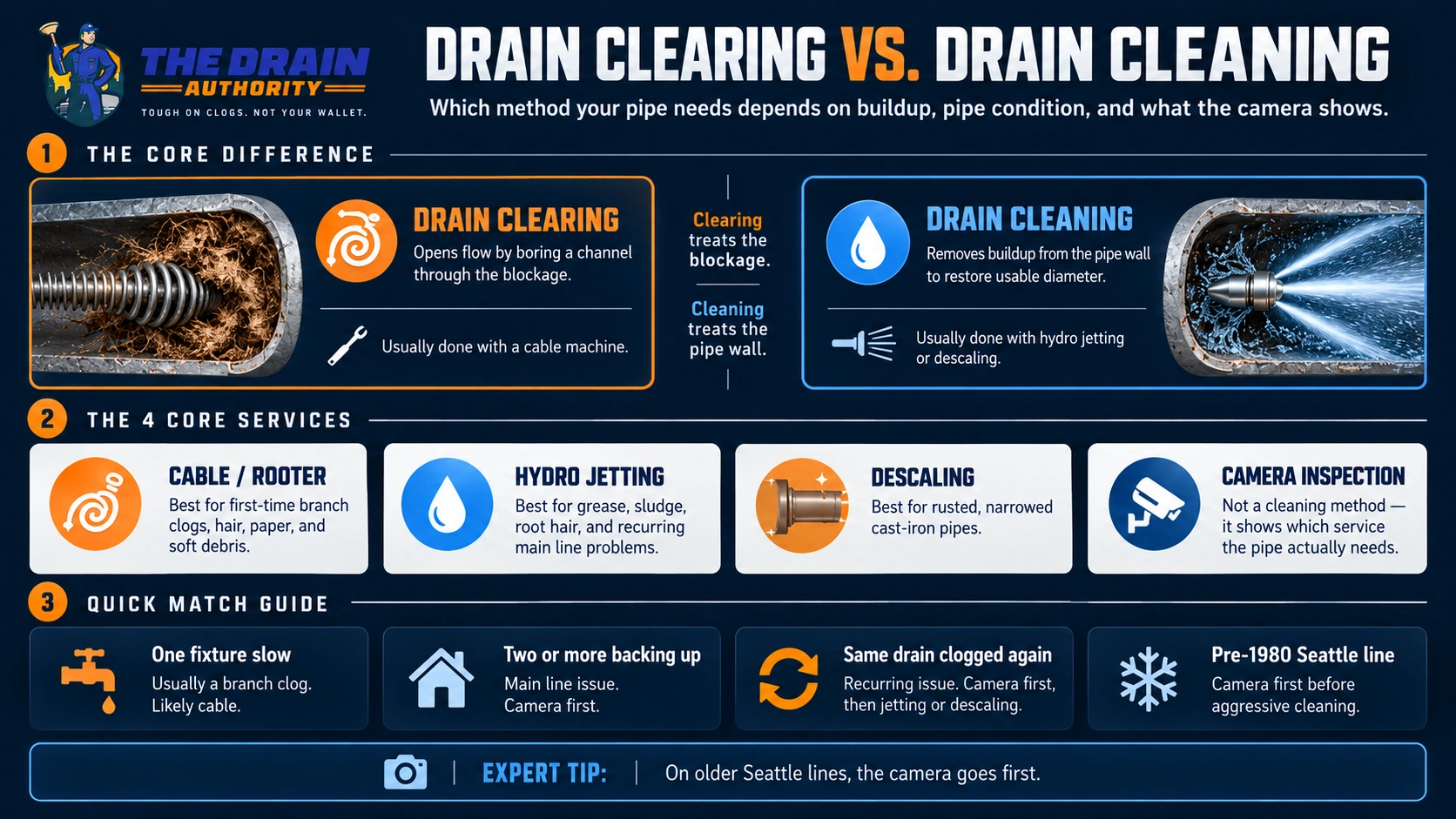
Everything a legitimate Seattle drain company does falls into these four. A technician who offers only one of them will find a way for your pipe to need that one.
A motorised drum feeds flexible steel cable into the line with a cutting or retrieving head on the end. Head selection is the part homeowners never see and the part that separates a competent operator from a guess: a grease head, a root-cutting blade and a retrieval auger behave completely differently, and using an oversized head in a corroded branch is how pipe gets damaged.
One fixture is affected and has not clogged before. Bathroom lines packed with hair and soap. Any line where the material and condition are unknown and the pressure risk of jetting is not worth taking. It is the fastest and cheapest professional option, and on a sound pipe it fully resolves the problem.
Buildup. A spinning head cuts a passage through grease or a root mass and leaves the wall coated, which is exactly why a snaked kitchen main so often reclogs before the next season. See rooter service in Seattle for equipment detail, or clogged drain service if a single fixture is the whole problem.
Hydro jetting, also sold as drain jetting or hydrojet drain cleaning, uses a high-pressure pump to drive water through a hose to a nozzle with rear-facing jets. The jets propel the hose forward and simultaneously blast the pipe wall as it travels. Cleaning happens on the way back: the operator draws the hose out slowly and the reverse thrust strips the circumference. Pressure is matched to pipe condition, not run at maximum because the machine is capable of it.
Fragile pipe. Pressure finds the weakest point in a line, and on separated clay or heavily deteriorated cast iron the weakest point is a joint that was already failing. Any Seattle line installed before roughly 1980 gets a camera pass first so pressure can be matched to condition or the method ruled out. We work through the full decision in hydro jetting near me: worth it or overkill, with equipment and pressure ranges on the Seattle hydro jetting service page.
Cast iron drain lines in Seattle homes from the 1930s through the 1960s develop tuberculation: a rough, rust-based crust that grows inward until a four-inch pipe carries like a two-inch pipe. Water still moves, so the homeowner assumes the line is fine, and every cleaning appears to work for about a month. On camera it looks like the inside of a barnacled hull.
Water pressure alone will not remove it. Descaling uses chain knockers or rotating carbide heads to mechanically abrade the nodules back to bare metal, and it is frequently the step immediately before a liner — you cannot line a pipe whose interior surface is still crusted. If a company has jetted your cast iron twice and it keeps closing up, pipe descaling in Seattle is the conversation you should be having instead.
A sewer camera — a drain camera, in most listings — is a self-levelling head on a push rod that runs the line while a locator transmits its position to the surface, so a defect can be marked in the yard within a foot or two. The footage answers the only question that matters on a recurring problem: is this a blockage that cleaning fixes, or a pipe defect that cleaning postpones?
Bellies, offset joints, separated clay, crushed sections and root entry points all present identically from inside the house — as “a clog” — and all cost different money to resolve. The industry has a standardised grading language for exactly this, the NASSCO Pipeline Assessment Certification Program, which is worth knowing exists: a contractor describing findings in PACP terms is describing them in a language another contractor can audit.
Ask for the footage, every time. A sewer camera inspection in Seattle gives you a recording, and that recording is your leverage when comparing repair bids. If a company recommends excavation and will not show you the screen, that refusal is the answer.
| Cable / rooter | Hydro jetting | Descaling | |
|---|---|---|---|
| Mechanism | Rotating steel cable | High-pressure water, rear jets | Chain knocker or carbide head |
| Best on | Hair, paper, soft debris, first clogs | Grease, sludge, root hair, recurring mains | Tuberculated cast iron |
| Camera first? | Not for a first branch clog | Yes on any pre-1980 line | Always |
| Risk if misapplied | Repeat callbacks, cause never found | Blowout on cracked or offset clay | Overspend on pipe needing replacement |
Run this before you call anyone. It takes about a minute and it changes what you are able to ask for.
Fill every sink and tub in the house, then release them one at a time. If only the original fixture is slow and everything else clears, the blockage sits in that fixture’s branch line, usually within twenty-five feet. Method: cable. A camera is not required for a first-time branch clog in a line that has never given trouble.
Flush a toilet and watch the tub. If the tub burbles or rises, or the toilet drops and gurgles when the washing machine drains, the restriction is downstream of where those lines join — you are in the main. In a Seattle basement house the lowest fixture always floods first. Method: main drain cleaning, also called main sewer line cleaning, plus a camera to find the cause, not just the clog.
Recurrence is diagnostic. A line that clogs on a schedule has a cause that cabling is not addressing — a coating, a root entry point, or a defect holding solids. Method: camera first, then jetting or descaling depending on what the footage shows. Booking another cable visit here is the most common way Seattle homeowners spend $1,200 solving a $700 problem.
This is close to a Seattle signature. A line carrying a sixty percent restriction moves household wastewater without symptoms for months, then fails once groundwater and stormwater start entering through roof drains, area drains and gaps in the pipe itself. It is suddenly moving volume it was never sized for. Method: camera in early autumn, cleaning before the wet season — an October inspection is worth considerably more than a January emergency call.
STOP RUNNING WATER AND CALL
Sewage surfacing in a tub, shower or floor drain. Water pooling in the yard over the sewer route. Sewage odour in a crawlspace. This is emergency drain cleaning territory. Stop all water use including dishwashers and washing machines on timers, and get a technician out the same day. Seattle Public Utilities also asks residents to report active sewer backups at (206) 386-1800 so the city can rule out a problem on the public mainline before you pay for work on yours.
Backing up right now? Do not run any more water. Call and we will route a technician to you today.
Roughly 43% of Seattle housing predates 1980 and around 10% predates 1940. Material tracks that timeline closely enough that an experienced technician knows which failure mode to look for before the camera goes in. That is the practical difference between a diagnostic visit and a guessing visit.
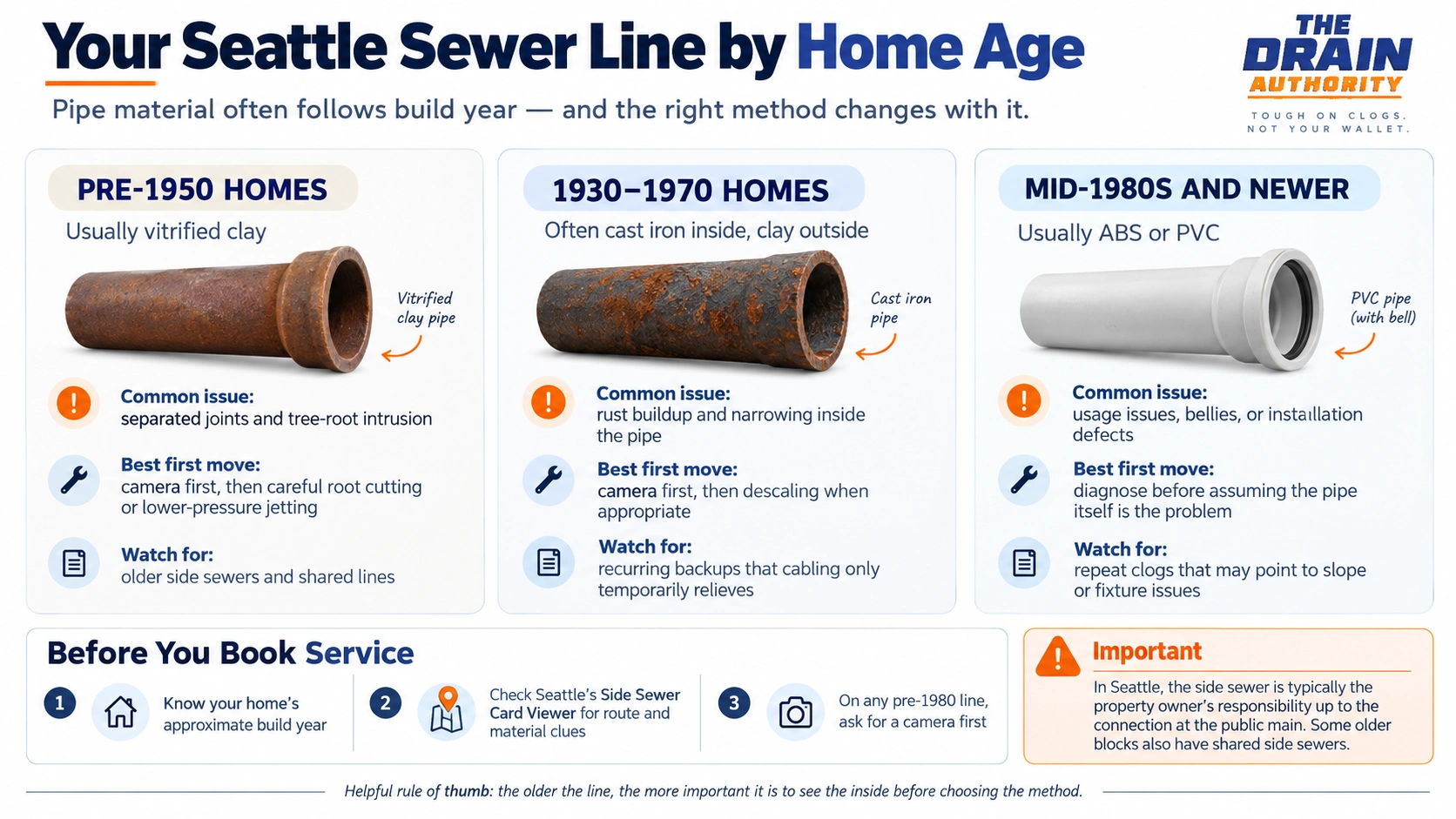
Short sections with mortared bell-and-spigot joints. The pipe body is remarkably durable; the joints are not. Soil movement settles them, mortar fails, and a gap opens that roots find. Clay is the reason jetting pressure has to be earned rather than assumed — a nozzle that meets a separated joint at full pressure will widen it. Cable with a properly sized root head, or jetting at reduced pressure after a camera pass.
Usually the interior stacks and horizontal runs under the slab, often paired with clay outside. Corrodes from the inside out and tuberculates. This is the material where the method question is most frequently answered wrongly, because jetting produces a visible improvement that lasts weeks and descaling produces a permanent one. Wallingford, Fremont and Green Lake generate more descaling candidates than any other part of the city.
Solvent-welded joints that stay sealed, smooth interior walls that resist buildup. When a modern line clogs repeatedly, the pipe is almost never the cause — look at usage, disposal habits, a fixture-level defect, or a belly created during installation. Washington adopts the Uniform Plumbing Code by reference in WAC 51-56, which governs the slope and support requirements that determine whether a run holds water.
We go deeper on age-specific failure patterns in drain cleaning in older Seattle homes, and on the single most common cause of repeat main line failure in tree root drain clogs in Seattle.
Seattle maintains scanned side sewer cards — the original permit drawings filed when a property’s sewer was installed or altered — searchable by address for free through the Side Sewer Card Viewer. For a 1927 house the card may be the only record of route, material, and whether the line was ever shared or rerouted. Five minutes there tells you the likely material before anyone opens a cleanout, and a second card usually means a prior repair, which narrows where to camera first.
Worth knowing while you are there: in Seattle that pipe is yours. Seattle Public Utilities is explicit that property owners own the side sewer up to the connection at the public mainline under Seattle Municipal Code Chapter 21.16, and that ownership continues under the parking strip, the sidewalk and the street. Many older blocks also have shared side sewers, where your line joins a neighbour’s before reaching the main — from that junction downstream, repair responsibility is split. Our Ballard Side Sewer Report documents how common the arrangement is across North Seattle’s pre-war blocks.
“Sewer line cleaning” is quoted by companies that mean very different amounts of work by it. Here is the sequence a complete job follows, so you can tell which version you have been sold.
Sewer drain cleaning done to this standard costs more than a call-out that stops at step two, and it is the difference between a line that stays open and one you book again in spring. Full scope and scheduling on our Seattle sewer line cleaning page. When the camera shows a defect rather than a blockage, that work moves to advanced plumbing services covering spot repair, trenchless lining and replacement.
Commercial drainage fails on a schedule, which means it can be managed on a schedule. That single fact changes the method conversation entirely: for a restaurant the question is not which service to buy once, it is what interval keeps the line from ever reaching failure.
Fats, oils and grease accumulate faster than any residential kitchen and health department compliance expects documented preventive maintenance rather than reactive calls. Quarterly jetting on kitchen mains is the interval that keeps a Seattle restaurant out of an emergency closure. Cabling a commercial grease line is close to pointless — the channel closes within days.
A different problem: a stack sized for one household now serving eight, plus a tenant population that will flush wipes regardless of signage. Capitol Hill and the Central District are full of these — original single-family drainage carrying four times the intended load. Semi-annual main line service plus an annual camera pass on any pre-1980 building is the pattern that prevents the 2 a.m. call. Details on our commercial drain cleaning page.
Method mismatches are rarely dishonest. Most drain cleaning companies in Seattle own one machine, and every problem resolves to that machine. These are the patterns worth recognising.
There is a structural point underneath all of this too: a general plumber and a drain specialist are not the same trade, and the equipment on the truck is the difference. We cover the cost consequences in why hiring a drain cleaner rather than just a plumber saves Seattle homeowners thousands.
Before booking anyone, run the company through Washington L&I’s Verify a Contractor tool. Confirm active registration, an active workers’ compensation account, a current bond, and any suits filed against that bond. It takes under a minute and eliminates a meaningful share of the operators advertising in this market.
Ranges for planning. Access difficulty, line length, pipe condition and after-hours timing all move the number, and any company should confirm in writing what a quote includes before work starts.
| Method | Seattle range | Triggered by |
|---|---|---|
| Single drain cable | $300 – $600 | One fixture, first occurrence |
| Main sewer line cleaning | $450 – $900 | Multiple fixtures, gurgling, lowest drain |
| Hydro jetting | $700 – $2,300+ | Recurrence, grease, root mass, scale |
| Sewer camera inspection | $300 – $500 | Before jetting, before any repair quote |
| Pipe descaling | $1,200 – $4,000+ | Tuberculated cast iron |
Observed Seattle metro ranges as of September 2026, standard business hours. Full breakdown including what moves each number in our Seattle drain cleaning cost guide.
Not sure whether you need a cable, a jetter, or a camera first? Tell us the symptoms and we will match the method to your pipe, not to an upsell.
Four items that measurably move a Seattle household from the jetting column back into the cable column.
On what is safe to attempt yourself and what damages pipe, see professional drain cleaning vs. DIY in Seattle, and for the broader list of what fails in local housing stock, 10 common plumbing problems in Seattle homes.
We operate out of Ballard at 5608 17th Ave NW, Suite 2025, Seattle, WA 98107, and serve King and Snohomish counties. Method selection is exactly where local knowledge pays: a technician who has opened fifty pre-war laterals in Ballard knows what the camera will show before it gets there, and quotes accordingly.
Full coverage on our Seattle drain cleaning service areas page.
Still Not Sure Which Service You Need?
Describe the symptoms and we will tell you whether it is a branch line, a main line, or something a camera has to answer first. No trip fees. Same-day service across the Seattle metro.
Open daily 8 AM to 8 PM | Licensed, bonded, insured | #DRAINDA756MA
Drain clearing reopens flow by boring a channel through a blockage, which is what a cable machine does. Drain cleaning restores the pipe to its original interior diameter by removing buildup from the wall, which is what hydro jetting and descaling do. That distinction explains most repeat service calls in Seattle: a cleared line still carries the grease, scale or root hair that caused the blockage, so it reforms. On a first-time clog in a healthy pipe, clearing is sufficient. On anything recurring, cleaning is what resolves it.
Choose snaking for a single fixture that has not clogged before, for bathroom lines packed with hair and soap, and for any line whose material and condition are unknown. Choose hydro jetting when the same line has clogged twice or more, when a camera shows a grease or sludge coating rather than a discrete object, when fine root hair has re-entered a joint, or on any commercial kitchen main. The deciding factor is pipe condition, not the severity of the symptom.
Hydro jetting is safe on older Seattle pipe only when a camera inspection confirms the line can take it and the operator matches pressure to condition. Intact vitrified clay and sound cast iron generally jet fine at reduced pressure. Pipe with existing cracks, separated joints or advanced deterioration should not be jetted, because pressure finds the weakest point. Any company proposing to jet a pre-1980 line without looking inside first is guessing with your sewer.
Descaling is the answer when cast iron has tuberculated, meaning rust nodules have grown inward until the effective diameter is a fraction of the original. The tell is a line that has been jetted more than once and keeps closing up within weeks, in a home built between roughly 1930 and 1970. Water pressure will not remove hardened scale; it needs mechanical abrasion from a chain knocker or carbide head. Descaling is also the required step before a pipe can be lined.
Not for a first-time clog in a single fixture on a line with no history. Yes before hydro jetting any Seattle line installed before 1980, yes on any recurring problem, yes before accepting any repair or replacement quote, and yes before buying an older home. The camera distinguishes a blockage that cleaning fixes from a pipe defect that cleaning only postpones, and those two findings carry completely different costs.
Flush a toilet and watch the bathtub. If the tub burbles or the water rises, or a toilet gurgles and drops when the washing machine drains, the restriction is downstream of where those lines join and you are in the main. Another reliable indicator is which fixture floods first: in a Seattle basement house the lowest drain always goes first. Two or more fixtures affected simultaneously is a main line problem until a camera proves otherwise.
Because a partial restriction that handles household wastewater comfortably cannot handle household wastewater plus groundwater. During Seattle’s wet season, stormwater and rising groundwater enter sewer lines through roof drains, area drains, sump connections and gaps in the pipe itself, and a line carrying a sixty percent restriction all summer suddenly fails. It is one of the most reliable seasonal patterns in this city and it is why an early autumn camera inspection is worth more than a January emergency call.
Correctly matched drain cleaning does not damage plumbing. Damage happens when method and pipe condition are mismatched: full-pressure jetting through cracked clay, an oversized cutting head in a corroded cast iron branch, or an inexperienced operator forcing a rented auger through a settled joint. The safeguard is inspection before aggressive methods on any line whose material and condition are unknown, which in Seattle means essentially anything installed before 1980.
Most homes need service only when symptoms appear. Three situations justify a schedule: homes built before 1980 with mature trees near the sewer route benefit from annual main line service, any home with a backup history should be inspected each autumn before wet season, and food service businesses generally need quarterly jetting. A practical rule is that if you are plunging or buying drain products more than twice a year, the underlying cause has not been addressed.
No. In Seattle the side sewer running from your building to the public mainline is privately owned, including the portion beneath the parking strip, sidewalk and street. Seattle Public Utilities is responsible only from the mainline connection onward. If your side sewer joins a neighbour’s before reaching the main, responsibility for that shared segment is split between the properties. SPU does ask residents to report active backups at (206) 386-1800 so the city can rule out a public-side issue first.
More answers in our full Seattle drain and sewer FAQ.
Sources & Further Reading
Method guidance and pricing reflect The Drain Authority’s observed Seattle metro practice as of September 2026 and are provided for planning purposes. Conditions on site determine the correct method and final cost. The Drain Authority is licensed, bonded and insured in Washington State, contractor registration #DRAINDA756MA.
Drain backed up? Get a flat price before we start.
Same-day service when the schedule allows. No trip fee to look. Open daily, 8 AM to 8 PM.

The Drain Authority is a Seattle drain and sewer cleaning company based in Ballard, serving homes and businesses across King and Snohomish counties.
5608 17th Ave NW, Suite 2025Recent Drain & Sewer Work
Real jobs from Seattle, Bellevue and Renton: roots, grease, scale, floor drains and sewer camera inspections.
Compare drain and sewer services© 2026 The Drain Authority LLC. All rights reserved. Powered by PSC


