
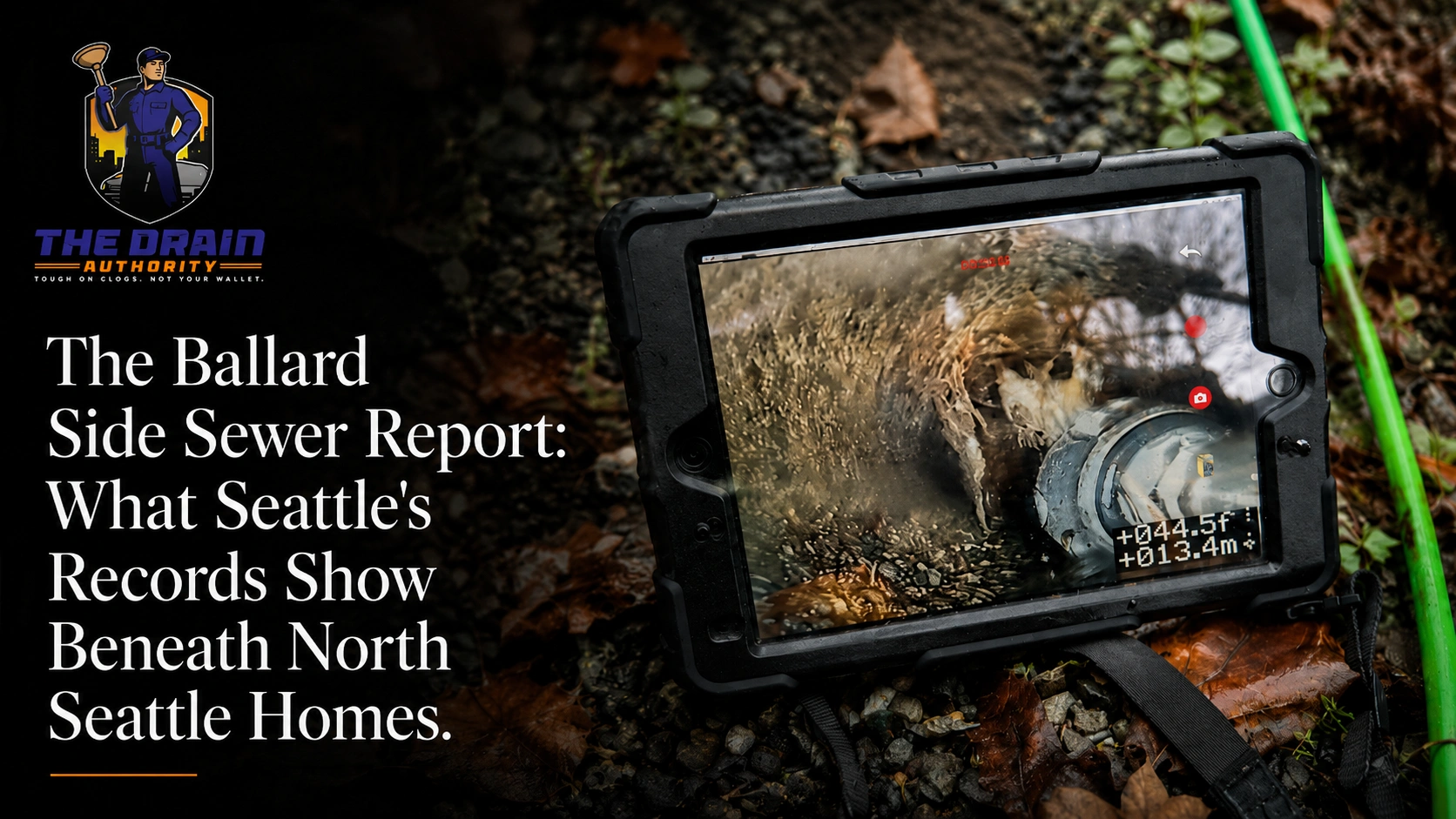
In Seattle, the pipe that carries wastewater out of your house is not the city’s pipe. You own it — all of it, from your foundation wall, under your yard, under the planting strip, under the sidewalk, and under the street, right up to the wye where it meets the public main. In a neighborhood like Ballard, where a large share of the housing stock predates World War II, that privately owned pipe is frequently older than anyone living above it.
This report compiles what Seattle’s own public records say about the sewer infrastructure under Ballard and North Seattle, combines it with field observations from drain and sewer service calls in the neighborhood, and lays out what it means for the person who actually holds the liability: the homeowner.
Every public figure below is sourced and linked. Journalists, agents, inspectors, and homeowners are welcome to reproduce the charts and findings with attribution. Terms and media contact are at the bottom.
A side sewer is the privately owned pipe that carries wastewater from a building’s sinks, toilets, and drains to the public sewer main in the street. Seattle Public Utilities is unambiguous about who owns it: the entire side sewer, all the way to the connection to the public main, is owned and maintained by the property owner. That includes every foot of pipe outside the building footprint — under the yard, under the planting strip, under the sidewalk, and under the roadway.
The practical consequence is that a homeowner can be responsible for a pipe failure located twenty feet beneath a public street they do not own, cannot access without a permit, and did not install.
Source: Seattle Public Utilities, Side Sewer Permits and Your Side Sewer. Diagram by The Drain Authority.
There is a second wrinkle specific to older, densely platted neighborhoods like Ballard: shared side sewers. When your pipe joins a neighbor’s pipe before reaching the main, SPU treats responsibility for the shared segment as joint. Seattle Municipal Code 21.16 assigns joint and several liability for that stretch — meaning a repair bill on a shared run has to be negotiated between neighbors who may not have known they were connected.
Homeowners can check both facts about their own property before there is a problem. Historic side sewer cards and lateral maps are searchable through SDCI’s Side Sewer Cards and Maps tool, and the underlying index cards go back to 1894 — meaning many Ballard properties have a paper record of the original connection. SDCI cautions that these are historical documents and should not be treated as a survey of what is actually in the ground today.
Ballard was an independent city until it was annexed by Seattle in 1907, and the Ballard Historical Society’s survey work notes that Ballard consistently topped every other Seattle neighborhood for pre-World War II growth. Lots were platted small and often double-platted, producing the dense, mixed-vintage streets that still define the neighborhood — a 1908 farmhouse next to a 1952 post-war box next to a 2019 townhouse.
Underneath, those three houses may be connected to the same main by three completely different generations of pipe. That variance is the single most important thing to understand about Ballard’s sewer picture: there is no neighborhood-wide answer, only a parcel-by-parcel one.
The second factor is the combined sewer. In Ballard, Fremont, Wallingford, and north Queen Anne, stormwater and sewage travel in the same pipes. Two-thirds of Seattle’s wastewater network is built this way.
Source: Seattle Public Utilities, 2025 Adopted / 2026 Endorsed Budget. Percentage calculated by The Drain Authority from SPU figures for combined and separated sanitary sewers.
When rain overwhelms a combined system, the mix discharges through overflow outfalls. That is the entire reason Seattle and King County built the Ship Canal Water Quality Project — a 2.7-mile, 18-foot-10-inch diameter tunnel running from Ballard to Wallingford, sized to hold 29 million gallons and cut overflows at six outfalls to an average of one per year or fewer. Construction continues in Ballard in 2026; My Ballard reported in August that pump station discharge pipe work resumed along Shilshole Avenue NW.
The tunnel addresses the public side of the system. It does nothing for the privately owned pipe between a Ballard house and that system — and a homeowner whose side sewer is already restricted will feel a heavy rain event first, and locally, in their own basement.
The most reliable predictor of what is under a Ballard house is the year the house was built. Sewer pipe materials came in and out of use in fairly tight windows, and each one fails in a characteristic way.
Seattle’s own regulatory paperwork encodes the age question directly. SDCI’s Side Sewer Evaluation and Certification Form uses two separate evaluation tracks — one for side sewers younger than 50 years, a stricter one for those older than 50 years. As of 2026, that line falls at 1976.
Sources: installation windows per the American Public Works Association; 50-year threshold per SDCI’s Side Sewer Evaluation and Certification Form. Failure modes are field observations by The Drain Authority. Chart by The Drain Authority.
One material is deliberately absent from the chart above because its Seattle installation window is harder to pin down: concrete. SPU notes that many Seattle side sewers are concrete pipe, which fails by a different mechanism — the interior cement wall erodes until the aggregate is exposed. Treat Figure 3 as the four materials whose eras are well documented, not as the complete list of what is under Seattle.
Orangeburg — bituminized fiber pipe made from wood pulp bound with coal tar pitch — was installed widely in homes built between roughly 1945 and 1972, when post-war metal shortages made cast iron scarce and expensive. It was marketed with a service life of about 50 years. The APWA notes that it was once thought to be impervious to roots, but as the tar pitch dries, moisture penetrates the pipe wall and roots find their way in. Production wound down in the early-to-mid 1970s as PVC took over; sources differ on the exact closure date of the main manufacturer.
The arithmetic is unforgiving. Even the youngest Orangeburg installation is now more than 50 years old, against a design life of 50 years at the optimistic end. The American Society of Civil Engineers puts typical wastewater pipe life at 50 to 100 years; Orangeburg sits at the bottom of that range. Its distinguishing behavior on camera is that it deforms into an oval well before it leaks — which is why it is often diagnosed as a “recurring clog” for years before anyone scopes it.
For Ballard’s mid-century infill blocks, this is the single highest-probability finding. The relevant question for a homeowner is not whether Orangeburg fails, but whether their particular lateral was ever replaced. That is answerable in an afternoon with a permit search and a camera.
Video: The Drain Authority. Camera footage is the only way to confirm pipe material, joint condition, and slope on a Seattle side sewer.
Root intrusion is the most-cited cause of Seattle sewer trouble, and the intuitive assumption is that leafier neighborhoods have more of it. Ballard complicates that. Data presented to Seattle’s Urban Forestry Commission from the 2021 Tree Canopy Assessment puts Ballard’s canopy cover at 17.3% — among the lowest in North Seattle, and well under the 28.1% citywide figure.
Source: Seattle Urban Forestry Commission briefing (June 2023), presenting 2021 Tree Canopy Assessment neighborhood data. Chart by The Drain Authority.
The explanation is that roots do not cause the failure — they exploit one. A root cannot enter an intact, gasketed pipe. It enters through a shifted clay joint, a hairline crack, or a wall that has gone permeable with age. SPU makes the point in its own homeowner guidance: a tree’s roots grow up to twice the tree’s height, so removing a tree above the line will not likely fix a root problem.
Video: The Drain Authority. Roots enter through a defect that already exists — a shifted joint, a crack, or a permeable pipe wall.
Which means the correct variable is pipe condition, not canopy. A modest street tree over a 1912 clay lateral will produce more trouble than a mature conifer over a 2004 PVC one. We cover the symptom side of this in more depth in our guide to tree root drain clogs in Seattle.
A restricted side sewer usually does not announce itself in July. It announces itself when groundwater rises, infiltration climbs, and the combined system is carrying stormwater at the same time.
Using NWS 1991–2020 climate normals for Sea-Tac, the October 1 to December 31 window carries 15.94 inches of normal precipitation across 92 days. The January 1 through July 31 window carries 20.84 inches across 212 days. That works out to about 0.17 inches per day in the fall window against 0.10 inches per day the rest of the year.
Source: calculated by The Drain Authority from National Weather Service climatological normals (1991–2020) for Seattle-Tacoma International Airport. Figures are seasonal averages, not any single year.
The NWS notes separately that November is typically Seattle’s wettest month, with measurable rain on an average of 18 of its 30 days. The practical implication for homeowners: the useful window for a camera inspection or a preventive cleaning is late summer and early fall — before the load arrives, not during it.
The sections above describe the system from the public record. This one describes what shows up on the camera monitor when we run a line in Ballard.
A note on what this is and isn’t. The following is field observation from our technicians, ordered by how often we encounter each condition. It is not a counted study, and we have deliberately not attached percentages to it. A service-call sample is drawn entirely from properties where something already went wrong, so any rate calculated from it would overstate how common these conditions are across Ballard’s housing stock generally. We would rather describe what we see accurately than quantify it misleadingly.
In Ballard’s pre-1950 housing this is the default finding. Vitrified clay was laid in short sections with mortared or gasketed joints, and eight decades of soil movement opens them. Roots do not break the pipe — they find the joint that has already moved, then thicken inside it until flow drops.
Cast iron does not usually fail suddenly. It corrodes inward, and the effective diameter shrinks year over year until an ordinary load backs the line up. Homeowners describe this as the drains “getting slower,” which is exactly what is happening — the pipe is smaller than it was.
On mid-century blocks, the tell is an oval cross-section rather than a hole. The pipe loses its round shape long before it leaks, so it reads as a stubborn recurring clog for years. Once it has gone oval, cleaning restores flow only briefly — the geometry is the problem.
A modern PVC or ABS lateral is not automatically a healthy one. If the trench bedding settled after backfill, the line develops a sag that holds standing water permanently. Solids drop out at the low point. This is a bedding failure, not a pipe failure, and it happens on lines only a couple of decades old.
SPU notes that many Seattle side sewers are concrete, and describes the characteristic failure: as the interior cement wall wears away, the aggregate underneath becomes exposed. On camera it reads as a rough, pebbled interior rather than a smooth bore — a surface that catches solids and gives roots somewhere to hold.
Ballard’s small, frequently double-platted lots produce shared runs that neither neighbor knew about until the camera reaches a junction that shouldn’t be there. The repair conversation then becomes a conversation between two households about a jointly owned pipe.
Almost none of these conditions arrive as an emergency. They arrive as a slow fixture, a gurgle, a drain that clears and then clogs again six weeks later. The emergency is what happens when that pattern gets ignored through a fall and the first sustained rain of the season pushes an already-restricted line past its remaining capacity.
Video: The Drain Authority, Seattle.
“The part that catches people off guard isn’t the pipe. It’s finding out the pipe is theirs. I’ve stood in a lot of Ballard yards explaining that the line under the sidewalk and half the street belongs to the homeowner, and nobody told them that when they bought the house. By then we’re usually looking at a line that’s been sending signals for two or three years — a slow tub, a gurgle in the basement — and the camera just confirms what the house was already saying.”
The useful takeaway for a Ballard homeowner is that the diagnostic step is cheap relative to the repair, and it is the only step that distinguishes a cleaning problem from a structural one. Everything after that is a decision made with information rather than without it.
None of this requires panic, and most of it costs nothing to start.
Search your address in SDCI’s Side Sewer Cards and Maps tool. You will often find the original connection date, the route, and whether the line is shared with a neighbor. Records go back to 1894.
If the house went up between 1945 and 1972 and there is no permit record of a lateral replacement, plan as though Orangeburg is in the ground until a camera says otherwise.
A sewer camera inspection in Ballard answers the material, condition, and slope questions in one visit. Late summer is the right time; December is not.
Roots in an otherwise sound pipe are a cleaning problem. A deformed or collapsed pipe is not — no amount of hydro jetting in Ballard repairs structure. Insist on seeing the footage before authorizing either.
If a repair is unavoidable, SPU recommends getting at least three bids before starting work. Income-qualified Seattle homeowners may be eligible for the city’s Side Sewer Assistance Program, which provides 0% interest loans for emergency side sewer repair to owner-occupants at or below the program’s income limits.
Not every root finding is an emergency, and SPU publishes its own guidance on how to respond to each severity level. If a camera inspection turns up roots, this is the schedule the city itself points homeowners to.
| Severity | Effect on the pipe | SPU guidance |
|---|---|---|
| Minor | Typically no effect on how the pipe functions. | Re-inspect three to five years after the original inspection. |
| Moderate | May or may not affect function now, but intrusion is likely to worsen over time. | Re-inspect three to five years after the original inspection. |
| Severe | Roots obstructing 50% or more of the pipe; can or will affect working condition. | Re-inspect every one to two years and perform routine cleaning. |
Source: Seattle Public Utilities, Side Sewer Defects & Issues. Summarized by The Drain Authority.
The useful thing about this table is what it rules out. A minor root finding does not require a repair quote — it requires a calendar reminder. Anyone who scopes a line, finds light root hair, and immediately recommends replacement is not following the city’s own standard.
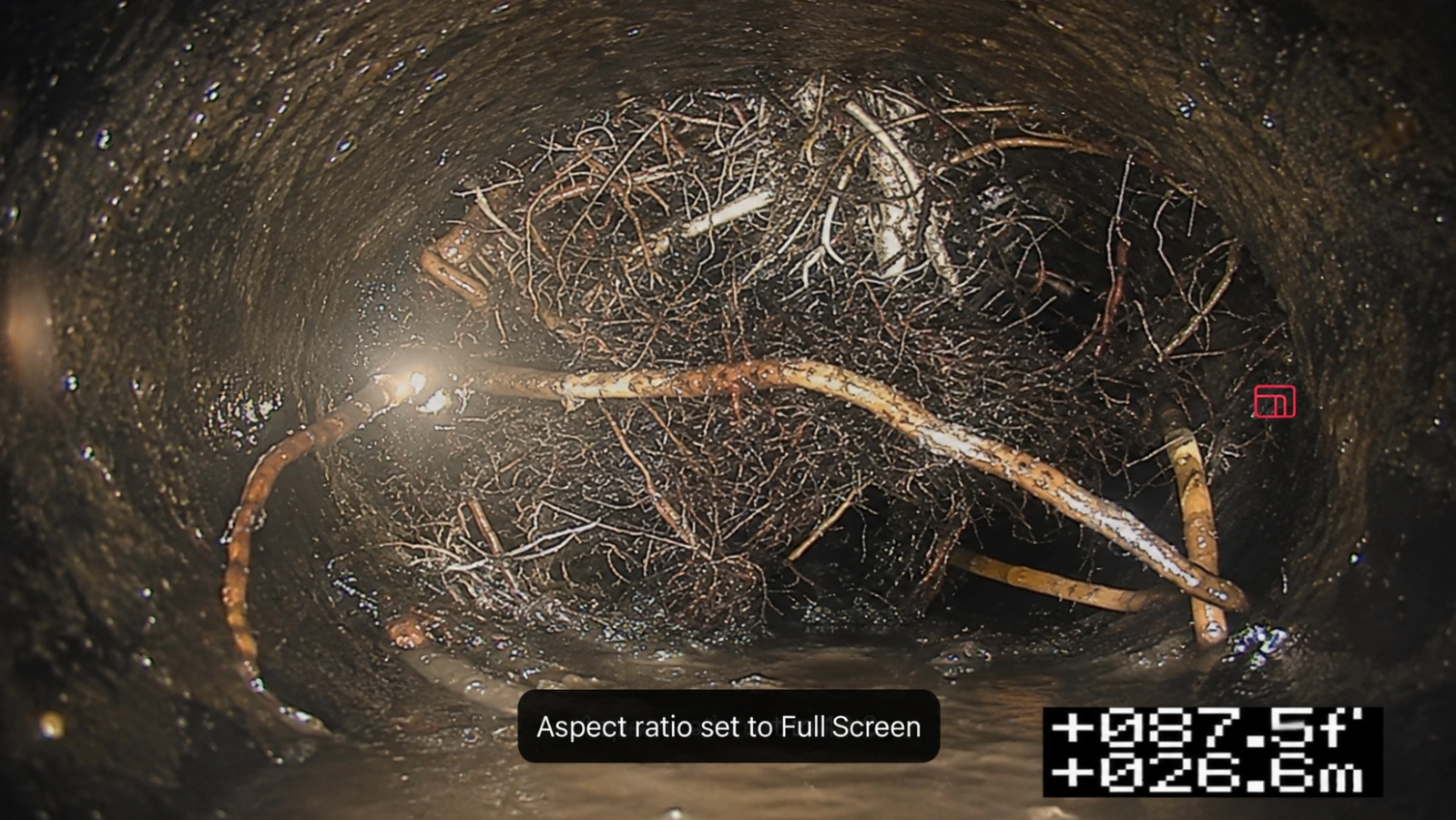
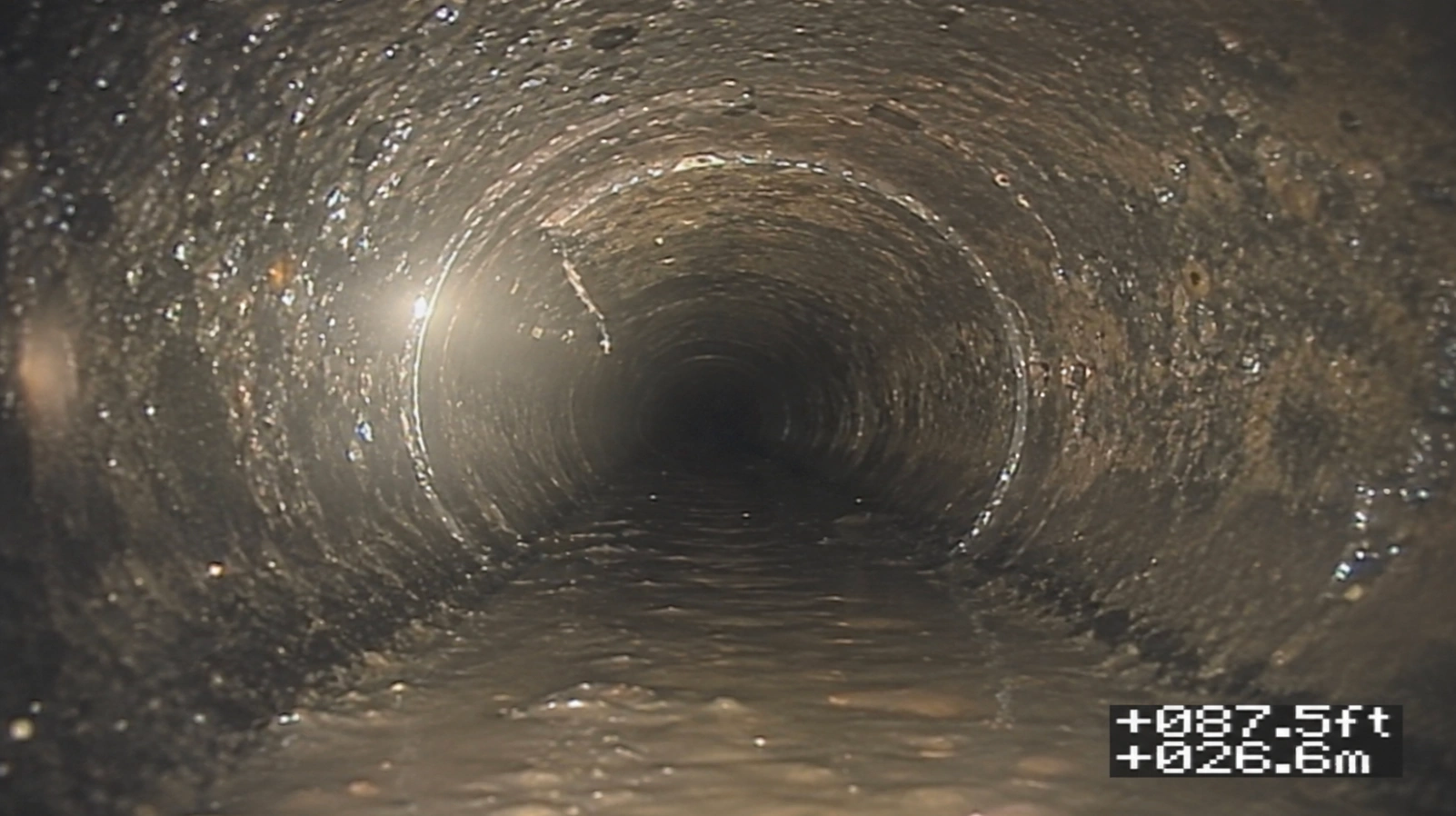
Images: The Drain Authority. Camera footage from a Seattle sewer line before and after root removal — no excavation required at this severity.
For general service across the neighborhood and the wider metro, see our pages on drain cleaning in Ballard and drain cleaning in Seattle.
Public data. Infrastructure figures are taken directly from Seattle Public Utilities budget and program documents, SDCI permit and records guidance, EPA WIFIA project documentation, and National Weather Service climate normals. Where we calculated a figure ourselves rather than quoting one — the 68% combined-sewer share, and the daily precipitation rates in Figure 5 — the calculation and its inputs are stated in the figure note.
Tree canopy. Neighborhood canopy percentages come from a June 2023 Seattle Urban Forestry Commission briefing presenting 2021 Tree Canopy Assessment data. Neighborhood boundaries follow the Seattle City Clerk’s Neighborhood Map Atlas and may not match colloquial usage of “Ballard.”
Field observations. Section 6 is qualitative expert commentary from The Drain Authority’s technicians, describing conditions encountered on residential drain and sewer service calls at Ballard-area addresses. It is ordered by observed frequency. We have not attached percentages or counts to it, because a service-call sample is drawn only from properties where a problem already existed and any rate derived from it would overstate defect prevalence across Ballard’s housing stock. No customer addresses, names, or job-level details are referenced, and no street-level breakdown is published.
Limitations. This report does not claim to measure how often Ballard side sewers fail. It describes how they fail, why the neighborhood’s building history makes certain failure modes more likely than others, and what the public record says about who carries the cost. Where a statement is a sourced statistic, it is linked. Where it is a field observation, it is labeled as one. We have deliberately kept those two categories separate.
Corrections. If you find an error in this report, contact us and we will correct it and note the change.
The property owner. Seattle Public Utilities states that the entire side sewer — all piping outside the building footprint, up to but not including the tee, wye, or connection to the public main — is owned and maintained by the property owner. SPU is responsible for the main itself.
Search your address in SDCI’s Side Sewer Cards and Maps tool. The underlying index cards were kept from 1894 onward, so many Ballard properties have a record of the original connection. SDCI notes these are historical documents and should not be used to determine what is actually below ground today — a camera inspection confirms current condition.
If it was built between roughly 1945 and 1972 and there is no permit record of a sewer lateral replacement, Orangeburg is a live possibility. The material was marketed with a roughly 50-year service life, so even the newest installations are now past it. Only a camera inspection can confirm it.
Usually not. SPU’s guidance notes that a tree’s roots grow up to twice the tree’s height, so removing a tree above or near the line will not likely resolve root intrusion. Roots enter through an existing defect — a shifted joint or a crack — so the pipe condition is the variable that matters.
Late summer and early fall, before the wet season load arrives. NWS normals put average daily precipitation at about 0.17 inches per day from October through December, against 0.10 inches per day from January through July — roughly 1.8 times the load, on a system that is already combined in neighborhoods like Ballard.
Charts, findings, and figures in this report may be reproduced with attribution to The Drain Authority Seattle Side Sewer Report, 2026 and a link to this page. Higher-resolution chart files, additional detail, sewer camera footage, and interviews with our technicians are available on request.
Media contact: The Drain Authority — contact page
This report is published by The Drain Authority, a drain and sewer service company serving Seattle and the surrounding King and Snohomish County metro. It is intended as general information for property owners and is not a substitute for a site-specific inspection or engineering assessment.
Drain backed up? Get a flat price before we start.
Same-day service when the schedule allows. No trip fee to look. Open daily, 8 AM to 8 PM.

The Drain Authority is a Seattle drain and sewer cleaning company based in Ballard, serving homes and businesses across King and Snohomish counties.
5608 17th Ave NW, Suite 2025Recent Drain & Sewer Work
Real jobs from Seattle, Bellevue and Renton: roots, grease, scale, floor drains and sewer camera inspections.
Compare drain and sewer services© 2026 The Drain Authority LLC. All rights reserved. Powered by PSC


