

Seattle Sewer & Utility News
Lynnwood, WA — August 16, 2026 | By The Drain Authority
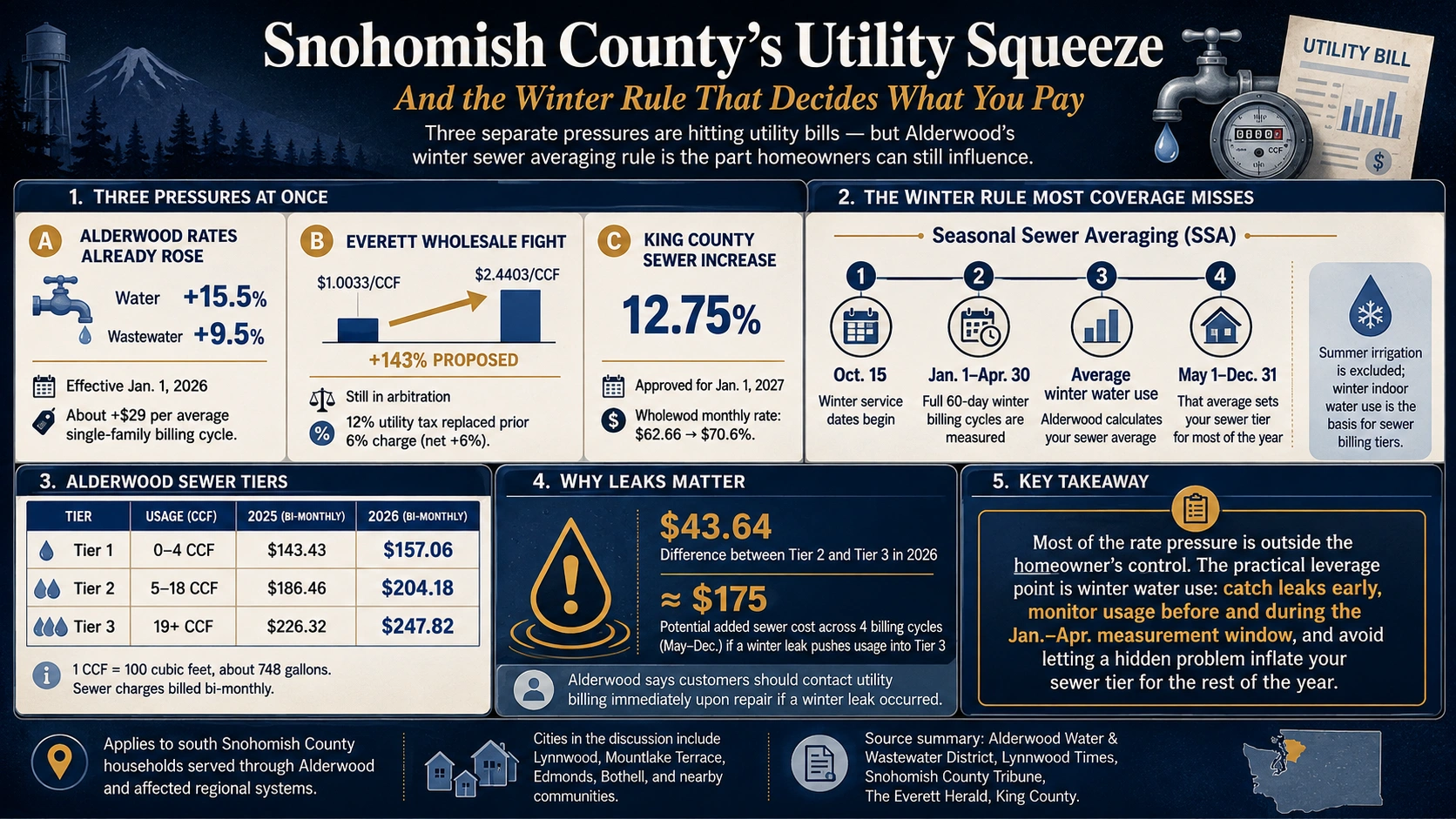
Snohomish County households are getting squeezed from three directions at once this year: Alderwood Water & Wastewater District raised water rates 15.5% and sewer rates 9.5% in January, Everett has proposed a wholesale water increase that Alderwood is fighting in arbitration, and King County’s separate 12.75% sewer increase lands on January 1. Every outlet covering this has framed it as a water-rate story. Almost nobody has mentioned the rule that decides how much of it you actually pay — and the window to do anything about it opens in October.
Start with the increase that is not in dispute. Alderwood’s Board of Commissioners adopted new rates for 2026, 2027 and 2028 across both systems. Effective January 1, 2026, the water rate increase was 15.50% and the wastewater increase was 9.50%. The district’s own illustration puts the effect on an average single-family account at roughly $29 more per billing cycle, and tells combined-service customers to apply about 11.18% to estimate their change.
The district is also candid about where this goes. Asked on its own rates page why rates are rising, Alderwood points to costs for products and services plus capital investment in the water and wastewater systems — and states plainly that it anticipates 15% to 30% increases in cost over the next three to five years.
Here is what that produced for single-family sewer charges, which are billed bi-monthly and tiered by water use:
| Alderwood single-family sewer tier | Usage level | 2025 bi-monthly | 2026 bi-monthly |
|---|---|---|---|
| Tier 1 | 0–4 CCF | $143.43 | $157.06 |
| Tier 2 | 5–18 CCF | $186.46 | $204.18 |
| Tier 3 | 19 CCF and greater | $226.32 | $247.82 |
Source: Alderwood Water & Wastewater District published rate schedules. One CCF is 100 cubic feet, about 748 gallons.
Most of south Snohomish County drinks water that Everett sells wholesale. Lynnwood buys from Alderwood, which buys from Everett. According to the Lynnwood Times’ account of a July 6 council briefing, Everett proposed raising its wholesale rate from $1.0033 per CCF, the 2024 rate, to $2.4403 for 2026 — an increase of about 143% that includes a 12% utility tax routed to Everett’s general fund rather than its water utility. Everett’s stated reason is an $80 million project replacing an aging underground reservoir with two new concrete reservoirs.
Alderwood is contesting it and continues to pay the 2024 rate while arbitration runs. Lynnwood’s public works director told the council the city would owe a $1.7 million true-up in April 2027 if arbitration goes against them, that about $1.5 million is already set aside for it, and that the longer arbitration drags on, the larger that true-up becomes. On the water portion alone, Lynnwood residents currently average $68.66 bi-monthly, or $75.53 with the city’s 10% utility tax; under the proposed rate that average would rise to $83.56, or $91.92 with the tax.
The tax piece is worth separating out. The Snohomish County Tribune reported on July 29 that Everett replaced its longstanding 6% payment-in-lieu-of-taxes charge with a 12% utility tax — a net 6% increase — which could generate $7.5 million for Everett’s general budget. The city of Snohomish expected to ask its own council to approve a pass-through as soon as its August 18 meeting. Everett’s four largest wholesale water customers are Alderwood, Monroe, Lake Stevens PUD and Marysville.
Meanwhile Edmonds voted in late July to extend its temporary 20% utility tax through the end of 2028, after raising it from 10% in December 2025. Edmonds officials have said the disputed wholesale increase would hit the city’s utility fund by more than $1.4 million a year and could force local rate increases of its own.
Two numbers to keep straight: the 12% utility tax is a net 6% increase over the old payment-in-lieu-of-taxes charge and is already in effect. The 143% figure is the proposed change in the wholesale rate per CCF between 2024 and 2026, and it is still in arbitration. They are not the same thing, and several summaries have blurred them together.
There is a fourth pressure that Snohomish County coverage has largely left out, because it comes from a different county entirely. King County’s Wastewater Treatment Division sells wholesale treatment to 33 cities and local sewer utilities across King, Snohomish and Pierce counties. Its 12.75% increase for 2027 was approved unanimously in June, taking the wholesale monthly rate from $62.66 to $70.65 on January 1 — with double-digit increases projected for several years after that.
Behind that sits a financing question with a hard date. The federal water infrastructure funding that has helped hold down regional borrowing costs expires on September 30, and King County named competing for those low-interest loans as one of five levers it intends to pull to slow the rate curve. So the household in Lynnwood or Mountlake Terrace reading about a water arbitration in Everett is also, separately, absorbing a King County treatment increase and a federal financing question. None of those three parties are talking to each other about the combined effect on one bill.
The same is true just across the county line. Shoreline and Lake Forest Park sit inside King County’s treatment system while sharing a border with Mountlake Terrace and Edmonds — same neighborhoods, same housing stock, different rate authorities entirely.
Here is the part with actual leverage in it, and we have not seen a single news story mention it: in Alderwood’s territory, your sewer bill for most of the year is set by how much water you use in winter.
The district uses what it calls Seasonal Sewer Averaging. For individually metered single-family accounts, water use from full 60-day billing cycles dated January 1 through April 30 is averaged, and that average sets the sewer tier applied to every billing period from May 1 through December 31. The stated purpose is protective — it means summer irrigation, car washing, pool filling and pressure washing do not inflate your sewer charges. Winter billing periods carry service dates from October 15 through April 30.
Now put that next to the tier table. Alderwood says typical two-month single-family use is 14 CCF, and about 11 CCF during winter cycles. Tier 2 runs from 5 to 18 CCF. Tier 3 starts at 19. That means a typical household sitting near 11 CCF has roughly 8 CCF of headroom — about 6,000 gallons across a two-month winter cycle — before it crosses into the top sewer tier.
An undetected leak, a toilet that runs continuously, or a failed fill valve can consume that headroom during exactly the months the district is measuring. And the penalty does not end when you fix it. The difference between Tier 2 and Tier 3 in 2026 is $43.64 per bi-monthly cycle, and the SSA tier governs four billing cycles from May through December. A winter problem you never noticed can therefore add roughly $175 to the sewer half of your bill across the rest of the year, on top of every increase described above.
Alderwood does provide a remedy, and it is easy to miss: the district asks customers who had a water leak during the winter billing quarter to contact utility billing immediately upon repair, and says timely notification is required for the Seasonal Sewer Average to be adjusted correctly. Immediately upon repair. Not at the end of the year when the bills look wrong.
The practical calendar is unusual, and it starts sooner than most people expect. Winter service dates begin October 15. The measured window that sets your 2027 summer sewer tier runs January 1 through April 30. That makes early fall the right time to deal with anything you have been putting off, and the wrong time to discover it.
Two categories of problem are worth separating. Water-side issues — a running toilet, a leaking supply line, a dripping fixture — drive the metered volume that sets your tier, and they are worth chasing down before mid-October. Drain-side issues do not affect the meter, but they are the ones that turn into a four-figure emergency at the worst possible time, and they are also the only part of this entire situation you actually control. Everything else on this page is decided by a district board, a city council, an arbitrator, or Congress.
South Snohomish County has a lot of housing stock from the 1950s through the 1970s, which means a lot of original clay and cast-iron side sewer running under mature landscaping. A camera inspection is the only way to know whether you are looking at routine buildup, root intrusion, a bellied section, or a line near the end of its life — which is why we run sewer camera inspections in Lynnwood and Edmonds as a diagnostic step before quoting anything.
What the camera finds determines the fix, and the fixes are not interchangeable. Roots in a joint call for cutting and clearing, which is what rooter service in Lynnwood is for; we walked through how tree roots get into a sewer line in more detail separately. Hardened scale inside old cast iron is a different problem, and pipe descaling in Bothell restores the original pipe diameter rather than just punching a hole through the blockage. Years of accumulated grease and sludge along the full run usually calls for hydro jetting in Mountlake Terrace and the surrounding cities. And if the problem is the main line rather than a branch, main sewer line cleaning in Edmonds scheduled on your terms costs a fraction of the same job at 11 p.m. on a holiday weekend.
One more caution worth stating plainly given the direction bills are heading: when utility costs climb, the very cheap advertised drain special starts looking better than it is. It is worth understanding how the $99 drain cleaning offers in this market actually work before you call the lowest number you can find.
We work across the affected area — Lynnwood, Edmonds, Bothell, Mountlake Terrace and the rest of the cities we serve across King and Snohomish County. If you want the full picture of how this work is priced and scoped before you call anyone, our drain cleaning guide covers it, and you can browse our full range of drain and sewer services.
The Everett arbitration will be settled by lawyers, the Alderwood rate schedule is already adopted through 2028, and King County’s increase is locked in for January. None of it is up for public negotiation at this point. What is still open is the part measured at your own meter between January and April, and the condition of the pipe running out to the street — which no rate case, tax vote or federal deadline has ever paid a dollar toward.
Effective January 1, 2026, Alderwood’s adopted water rate increase was 15.50% and the wastewater increase was 9.50%. The district’s illustration puts the effect on an average single-family account at roughly $29 more per billing cycle, and advises combined-service customers to apply about 11.18% to estimate their change. Rates have been adopted through 2028.
Two separate things are in play. Everett’s replacement of its 6% payment-in-lieu-of-taxes charge with a 12% utility tax — a net 6% increase — is in effect. The larger proposed wholesale rate change, from $1.0033 per CCF in 2024 to $2.4403 for 2026, is being contested by Alderwood, which continues to pay the 2024 rate while arbitration continues.
Alderwood uses Seasonal Sewer Averaging for individually metered single-family accounts. Water use from full 60-day billing cycles dated January 1 through April 30 is averaged, and that average sets the sewer tier applied from May 1 through December 31. The intent is to keep summer irrigation, car washing and pool filling from inflating sewer charges.
Alderwood asks customers to contact utility billing immediately upon repair, and states that timely notification is required for the Seasonal Sewer Average to be adjusted correctly. Waiting until the bills look wrong later in the year is too late. The difference between Tier 2 and Tier 3 in 2026 is $43.64 per bi-monthly cycle across four cycles from May through December.
For many of them, yes. King County’s Wastewater Treatment Division provides wholesale treatment to 33 cities and local sewer utilities across King, Snohomish and Pierce counties. Its approved 12.75% increase raises the wholesale monthly rate from $62.66 to $70.65 on January 1, 2027, and is separate from anything Alderwood or Everett decides.
Sources: Alderwood Water & Wastewater District — Rates; Lynnwood Times — Lynnwood City Council briefed on potential water rate hikes (July 7, 2026); Snohomish County Tribune — Everett utility increase to be passed on to Snohomish ratepayers (July 29, 2026); The Everett Herald — Edmonds extends temporary 20% utility tax through 2028 (July 29, 2026); My Edmonds News — Providers push back as Everett’s water rate increases could raise bills for 75% of county; King County — Sewer rate and capacity charge.
Drain backed up? Get a flat price before we start.
Same-day service when the schedule allows. No trip fee to look. Open daily, 8 AM to 8 PM.

The Drain Authority is a Seattle drain and sewer cleaning company based in Ballard, serving homes and businesses across King and Snohomish counties.
5608 17th Ave NW, Suite 2025Recent Drain & Sewer Work
Real jobs from Seattle, Bellevue and Renton: roots, grease, scale, floor drains and sewer camera inspections.
Compare drain and sewer services© 2026 The Drain Authority LLC. All rights reserved. Powered by PSC


