Three Utility Increases Land January 1, 2027. Here’s What the Stack Costs.
September 8th, 2026
King County · Utility Rates
SEATTLE, WA — September 8, 2026
By The Drain Authority | Reviewed by Shane Caldwell, Owner & Lead Drain Technician | WA Contractor Reg. #DRAINDA756MA
Three separate utility increases were approved this summer by three different bodies, and every one of them takes effect on the same day. On January 1, 2027, Seattle-area households will absorb a 12.75% King County sewer rate hike, a 9.5% Seattle City Light increase, and the third year of a 5% Seattle Public Utilities drainage and wastewater rate path — simultaneously. Each was covered on its own. Nobody has added them up.
Three increases, one billing cycle
Utility
2027 increase
Typical monthly impact
Status
King County wastewater treatment Wholesale rate charged to 34 local sewer agencies
12.75%
About $8 more on the wastewater treatment portion. Wholesale monthly rate moves from roughly $62.66 to $70.65
Approved unanimously by King County Council, June 23, 2026
Seattle City Light Electricity
9.5% and 9.5% again in 2028
About $10 more per month, then another $10 in 2028. Utility Discount Program customers about $5
Rate ordinance adopted by Seattle City Council, July 2026
Seattle Public Utilities Drainage & wastewater
5.0% sewer 5.1% drainage
Third year of a 5% average annual revenue path covering 2025–2027. SPU sewer rates already include the King County treatment charge above
Set in the adopted 2025–2027 rate study
One structural detail matters when you read that table: the increases are not fully independent. SPU’s sewer rate contains the King County treatment charge as a component, so the county hike flows through into the city bill rather than sitting beside it. SPU’s rate study describes an automatic passthrough mechanism for treatment increases under the municipal code.
What is independent is the electricity increase. City Light is a separate department with its own rate ordinance, and it lands the same month.
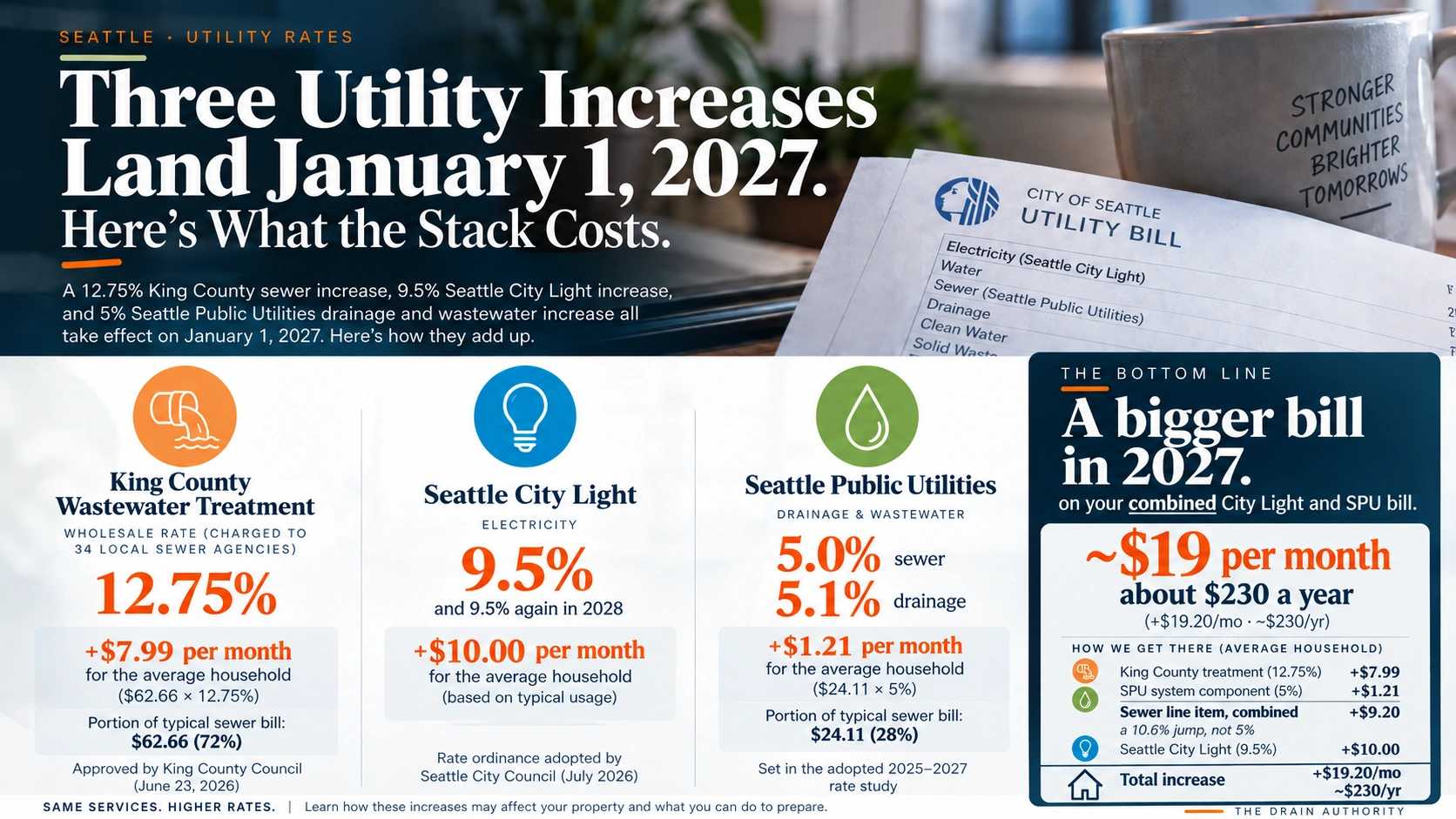
Stacked on a typical single-family bill, the three come to roughly $19 more per month, or about $230 a year. SPU puts a typical single-family customer at 4.3 CCF of wastewater a month, which at current rates makes for a sewer bill in the high $80s. Of that, about $62.66 — roughly 72% — is the King County treatment charge, leaving around $24 as SPU’s own system component. So the county’s 12.75% adds close to $8, SPU’s 5% on its own share adds about $1.20, and City Light adds about $10.
Which surfaces something the headline percentages hide. Because the county increase lands on nearly three-quarters of the sewer bill, the household sewer line item rises about 10.6%, not 5%. SPU’s 5% figure is an average revenue path across its own costs; it is not what a customer will see on the sewer line. One further clarification, since it is easy to double-count: the 5.1% drainage increase does not land on this bill at all. Seattle collects drainage with King County property taxes, shown as SWM on the tax statement.
The three increases and how they add up on a typical single-family bill: $19.20 more per month, about $230 a year. Credit: The Drain Authority — free to republish with attribution and a link.
What the 12.75% is buying
King County transmitted the 2027 rate proposal to the County Council on April 23, 2026, arguing the increase was needed to comply with state and federal regulations, maintain and modernize aging infrastructure — equipment that in some cases dates to the 1960s — and add capacity for a growing population.
“The proposed sewer rate will make sure our frontline professionals have the resources they need to protect the water that sustains life in our region,” King County Executive Girmay Zahilay said when the proposal was transmitted. The approved increase is expected to generate $676.2 million in revenue next year, and the underlying capital program runs to roughly $14 billion over the next decade — storage tunnels, pipe separation and treatment plant upgrades aimed at cutting overflows as storms intensify.
Council members approved it while saying plainly that they did not like the trajectory. “We are in violent agreement across this council and our partner jurisdictions that the wastewater treatment rates are going up at an alarming trajectory, and it is not sustainable,” Councilmember Claudia Balducci said at the June meeting. Council Chair Sarah Perry added that she does not view increases of that magnitude as sustainable.
Where the trajectory goes
Under the Wastewater Treatment Division’s current proposed plan, double-digit increases would continue annually for the next five years. If that holds, the monthly sewer rate reaches roughly $126 by 2032 — about double what customers pay today. Increases would continue after that at lower rates. Council members have said they are working with the division to find ways to slow the path.
King County monthly wholesale sewer rate
2026$62.66
2027 — approved, +12.75%$70.65
2032 — projected under current plan~$126
The 2032 figure is a projection under the Wastewater Treatment Division’s current proposed plan, not an approved rate. Only the 2027 increase has been adopted. Source: King County Council proceedings as reported by KIRO 7 and MyNorthwest, June 2026.
The angle most coverage is missing
You are paying more for a system that stops at your property line
Every dollar in that 12.75% goes to the regional system: treatment plants, trunk mains, storage, capacity for growth. It is real work and it is genuinely needed. It is also, without exception, work on infrastructure the ratepayer does not own.
The pipe that actually fails in a Seattle home is the side sewer — the private lateral running from the building to the connection at the public main, often beneath the sidewalk and out into the street. Seattle Public Utilities is unambiguous that maintaining and repairing that entire run is the property owner’s responsibility. No rate increase funds it. No capital program touches it. It does not appear anywhere on the bill.
So the household arithmetic for 2027 is worse than the headline. Your fixed utility costs rise on January 1, and the single largest plumbing liability attached to your property is still entirely uncovered and entirely on you. A failed lateral is a four- and sometimes five-figure event, and it competes for the same dollars the rate increases just claimed.
Why this is worse for older housing stock
The county is replacing 1960s equipment. The private laterals attached to a great deal of Seattle’s housing are older than that. Pre-war and mid-century homes across Ballard, Wallingford, Green Lake, West Seattle and the north-end suburbs typically sit on vitrified clay side sewers laid in short jointed sections — a design that leaks at the joints as soil settles, and that fine tree roots exploit within a season or two.
“When bills go up, the first thing people cut is anything preventive. I understand it. But the side sewer is the one place where deferring is genuinely more expensive — a jetting and a camera run is a fraction of what an emergency dig costs, and the emergency dig is what you get if you wait. If your budget just got tighter, that’s an argument for scoping the line this fall, not against it.”
— Shane Caldwell, Owner, The Drain Authority, Seattle
Help that exists, starting the same month
One piece of genuinely good news arrives on the same date as the increases. Seattle City Council passed an expansion of income eligibility for the Utility Discount Program, and the expanded eligibility begins January 1, 2027 — the same day the new rates take effect. The change moves the program from a state median income basis to area median income and extends it to households earning under 60% of AMI, reaching nearly 30% more customers, or more than 31,000 additional households.
Program
What qualifying customers receive
Utility Discount Program
60% off future Seattle City Light electricity bills and 50% off future SPU water, sewer and garbage bills. Average savings of roughly $120 to $205 each month
SPU Emergency Assistance Program
Credits toward a current outstanding water, sewer and garbage balance. For 2026, up to $1,074 a year for households with children under 18, and up to $537 for households without
Know the condition of your lateral before you need to. A sewer camera inspection turns an unknown liability into a scheduled decision. Ask for the recording.
Watch what your water use does to the sewer line item. Sewer charges are driven by metered water consumption. A running toilet or an irrigation leak inflates two utilities at once, and both just got more expensive.
Be sceptical of a headline price. A flat low-ball number almost always covers a cable through an accessible cleanout and nothing else. We broke down how that market works in the $99 drain cleaning problem in Seattle.
Clean the full diameter, not a channel through it.Hydro jetting removes the root mat and wall scale that cabling leaves behind, which is the difference between a fix that lasts a season and one that lasts several.
Verify the contractor. Check registration and bond status on the Washington L&I portal before anyone opens a cleanout.
Find out what your side sewer is worth before January
Camera inspection, root cutting and hydro jetting across King and Snohomish counties. Written findings and footage, so you can plan the spend instead of absorbing it.
How much is the King County sewer rate going up in 2027?
The King County Council unanimously approved a 12.75% increase for 2027, moving the monthly wholesale sewer rate from roughly $62.66 to $70.65. For a typical customer that is about $8 more per month on the county wastewater treatment portion of the utility bill. It takes effect January 1, 2027.
What other utility increases hit at the same time?
Seattle City Light rates rise 9.5% in 2027 and again in 2028, about $10 more per month each year for a typical residential customer and about $5 for Utility Discount Program customers. Seattle Public Utilities is in the third year of a rate path with 5% average annual revenue increases for wastewater and drainage across 2025 to 2027.
Will sewer rates keep rising after 2027?
Under the Wastewater Treatment Division’s current proposed plan, double-digit increases would continue annually for the next five years, which would put the monthly rate at roughly $126 by 2032 — about double today. Only the 2027 increase has been approved. Council members have said they are working with the division to slow the path.
Does any of this pay to fix the sewer pipe on my property?
No. The increases fund the regional system — treatment plants, trunk mains, storage and capacity. In Seattle the side sewer running from the building to the connection at the public main is the property owner’s responsibility to maintain and repair. No rate increase or capital program covers it, and it does not appear on the bill.
Is there help if the increase is a hardship?
Yes. Seattle expanded Utility Discount Program eligibility effective January 1, 2027 — the same day the new rates begin — extending it to more than 31,000 additional households. Qualifying customers get 60% off Seattle City Light bills and 50% off SPU water, sewer and garbage. The SPU Emergency Assistance Program provides credits toward a current outstanding balance, up to $1,074 a year in 2026 for households with children under 18 and up to $537 for households without.
The Drain Authority is a drain and sewer specialist serving King and Snohomish counties from Ballard. Rate figures are as approved and reported at time of publication; only the 2027 increases have been adopted.