Seattle’s New Side Sewer Review: What SPUE-IPR-26 Records Mean for Your Project
September 7th, 2026
Seattle · Code & Permitting
SEATTLE, WA — September 8, 2026
By The Drain Authority | Reviewed by Shane Caldwell, Owner & Lead Drain Technician | WA Contractor Reg. #DRAINDA756MA
On September 1, Seattle’s permitting agencies published two updates within an hour of each other. One was a housekeeping note on the 2026 Stormwater Code. The other announced that Seattle Public Utilities now reviews your sanitary and side sewer design at the same time SDCI reviews your building permit. Read separately they look like process minutiae. Read together they are the biggest change to how Seattle handles private drainage in years — and the burden lands squarely on property owners.
What was published on September 1
The Seattle Department of Construction and Inspections posted a status update on the 2026 Stormwater Code and Stormwater Manual, noting they have now been in effect for several months. The post directs applicants to use the new Stormwater Plan and, where required, the Small Construction SW Control Soil Management Standard Plan, both available on the SDCI Stormwater Code webpage. It also flags new “Stormwater Code 101” and “2026 Code Update” training videos, and a run of virtual question-and-answer sessions.
The second post, published the same day, is the one with teeth. Seattle Public Utilities has implemented a new process to review on-site sanitary sewer design and off-site points of connection for drainage and wastewater in parallel with SDCI’s building permit review — a change SPU says will mean fewer building permit revisions after issuance, faster issuance of side sewer permits for new construction, and less confusion during design and construction.
The new parallel review, decoded
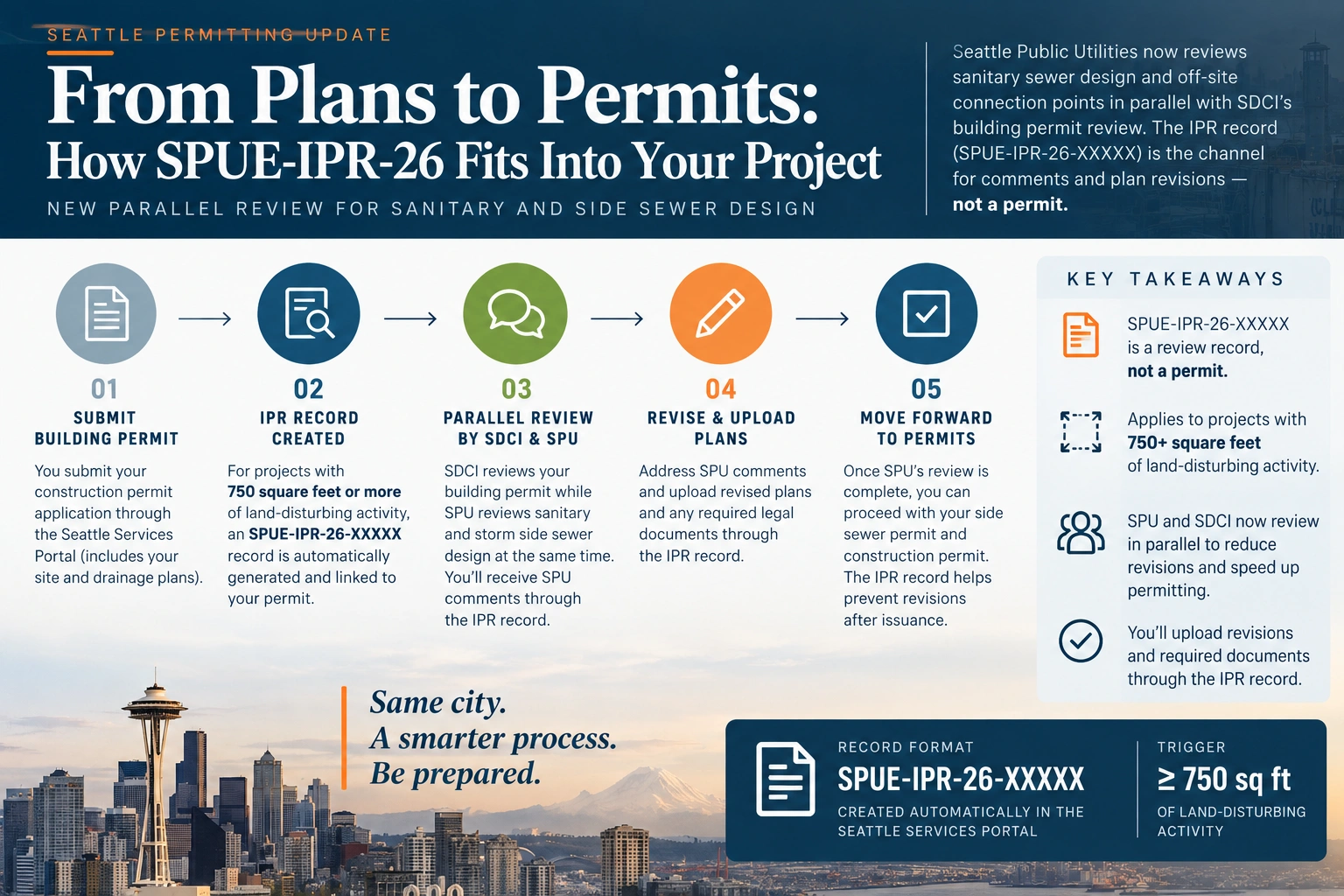
The review happens in the Seattle Services Portal under a record type called IPR. The records carry the format SPUE-IPR-26-XXXXX and are generated automatically for any project involving 750 square feet or more of land‑disturbing activity. Each IPR record is created from and linked to the construction permit.
The single most important thing to understand about them: an IPR record is not a permit and does not replace a construction or side sewer permit. It is the channel through which SPU sends review comments and through which you upload revised plans and required legal documents, so that when you do submit for the side sewer permit, it goes through.
The five stages of Seattle’s parallel sanitary and side sewer review, effective September 2026. Credit: The Drain Authority — free to republish with attribution and a link.
What the IPR record does
What it does not do
Delivers SPU’s required revisions to sanitary and storm side sewer design, including approved discharge points for drainage and wastewater
Authorize any construction. It is explicitly not a permit
Holds the reviewed Stormwater Plan that SPU attaches after review
Replace the side sewer permit or the construction permit
Collects required recorded legal documents — Memorandum of Drainage Control, Side Sewer Easement Agreement, Side Sewer Joint Use and Maintenance Agreement, Side Sewer Release and Indemnification Agreement
Cover on-site stormwater management or drainage lines on private property — those revisions still go to the construction permit
Runs concurrently with SDCI building permit review rather than after it
Get created for projects under the 750-square-foot land-disturbance threshold
SPU is fielding questions on the change at sidesewerinfo@seattle.gov, and maintains a full reference list of the documents that must be recorded for side sewer work.
Read your PAR — it is not the document it used to be
SDCI’s September 1 guidance singles out the Preliminary Assessment Report and asks applicants to read it carefully, because it now carries detailed information from both SDCI and Seattle Public Utilities covering the stormwater and wastewater requirements for a project. The stated intent is to front-load as much information as possible before plans are submitted.
That is a meaningful shift. Historically, an owner could get a building permit issued and only discover the side sewer constraints — where the connection is allowed, whether an easement has to be recorded, whether a shared lateral triggers a joint use agreement — well after design was locked. Those discoveries are the source of most expensive mid-project redesigns in Seattle drainage work. Moving them into the PAR and into a concurrent SPU review is the fix.
The angle most coverage is missing
Compliance ends at final inspection. Maintenance never does.
Both September 1 posts are written for the permit desk. They tell you how to get approval. Neither addresses what happens on the day after approval — and that is where the real cost sits.
The direction of Seattle’s stormwater regulation for a decade has been to keep more water on the parcel that generated it. Bioretention cells, permeable paving, drywells, detention, dispersion trenches. Every one of those is a facility that clogs, silts, compacts, or roots over. And every one of them is privately owned and privately maintained the moment the inspector signs off.
Add the sanitary side to that picture and the exposure compounds. The same SPU review that now approves your discharge point also documents the easements and joint-use agreements attached to your side sewer — which means the paperwork defining who is responsible for that private pipe is being created and recorded at permit time. Owners who never read it will find out what it says during a backup.
Who this actually hits in Seattle
Homeowners doing a DADU, addition or major hardscape. The 750-square-foot land-disturbance trigger is not a big number. A detached accessory dwelling unit with a driveway apron clears it comfortably. Those projects now generate an IPR record and a concurrent SPU sewer review whether or not the owner expected one.
Small commercial and multifamily owners. A new drainage facility on a small commercial site is an asset with an annual maintenance obligation nobody budgeted for. Silted bioretention and blocked area drains show up first as ponding in a parking area and later as water intrusion.
Anyone on a shared lateral. Older Seattle blocks are full of two-and-three-house private runs. The joint use and maintenance agreement SPU now collects at review time is the document that decides who pays when that run fails. Our Ballard Side Sewer Report maps how common those arrangements are in one representative neighborhood.
Expert commentary
“The parallel review is a good change — it catches the connection problem while the design can still move. What worries me is the second half. We’re handing people a drainage system on their own property and a recorded agreement about their own sewer line, and nobody hands them a maintenance schedule to go with it. Five years later I’m in the crawlspace explaining why a bioretention cell that was never cleaned is now the reason the foundation is wet.”
— Shane Caldwell, Owner, The Drain Authority, Seattle
Training and Q&A sessions still ahead
The SDCI stormwater review team has posted “Stormwater Code 101” and “2026 Code Update” training videos in the training section at the bottom of the SDCI Stormwater Code page. SDCI describes them as useful whether you are new to stormwater management or experienced with complex submissions.
The team is also running virtual question-and-answer sessions from 3–4 PM. The September 2 and September 9 sessions have been held; the remaining general session is September 16, followed by a September 22 session specifically for engineers. Meeting links are on the SDCI post, and anyone with a stormwater question is invited to whichever session fits.
The practical checklist
If you have a project in review, find your IPR record. It is in the Seattle Services Portal, linked to your construction permit, formatted SPUE-IPR-26-XXXXX. Comments and document requests land there, not on the CN.
Route revisions to the right record. Sanitary and storm side sewer revisions and legal documents go to the IPR. On-site stormwater management and private drainage line revisions still go to the construction permit.
Read every recorded document before you sign it. A Side Sewer Joint Use and Maintenance Agreement runs with the property. It will outlive your ownership and it will govern the next backup.
Get a baseline camera record at final. A sewer camera inspection in Seattle at project close gives you documented as-built condition. Every future dispute about who broke what starts from that footage.
Put the drainage facility on a calendar. Catch basins, area drains and detention lines need clearing on a schedule, not on failure. Hydro jetting is the standard tool for restoring full diameter in silted storm lines.
Verify your contractor’s registration. Check the bond and license status on the Washington L&I portal. Work recorded against a permit is work you want documented properly.
It is the Seattle Services Portal record type Seattle Public Utilities uses for its new parallel review of on-site sanitary sewer design and off-site points of connection. Records follow the format SPUE-IPR-26-XXXXX, are created from and linked to the construction permit, and are generated automatically for projects with 750 square feet or more of land-disturbing activity.
Does an IPR record replace my side sewer permit?
No. SPU states directly that IPR records are not permits and do not replace construction or side sewer permits. They exist so SPU can share review comments and so applicants can upload revised plans and required legal documents ahead of a successful side sewer permit submittal.
Which legal documents can SPU require?
SPU communicates required revisions to sanitary and storm side sewer design, including approved discharge points, along with required recorded documents such as the Memorandum of Drainage Control, the Side Sewer Easement Agreement, the Side Sewer Joint Use and Maintenance Agreement, and the Side Sewer Release and Indemnification Agreement.
Where do I upload on-site stormwater revisions?
Revisions to on-site stormwater management or drainage lines on private property continue to go to the construction permit. Requested documents for the sanitary and storm side sewer review are uploaded to the Seattle Services Portal against the IPR record.
Are there sessions where I can ask questions directly?
Yes. The SDCI stormwater review team is running virtual Q&A sessions from 3–4 PM. The September 2 and September 9 sessions have been held. One general session remains on September 16, plus a September 22 session for engineers. Side sewer questions can also be sent to sidesewerinfo@seattle.gov.
The Drain Authority is a drain and sewer specialist serving King and Snohomish counties from Ballard. This article is reporting and general information, not legal advice on any recorded agreement.