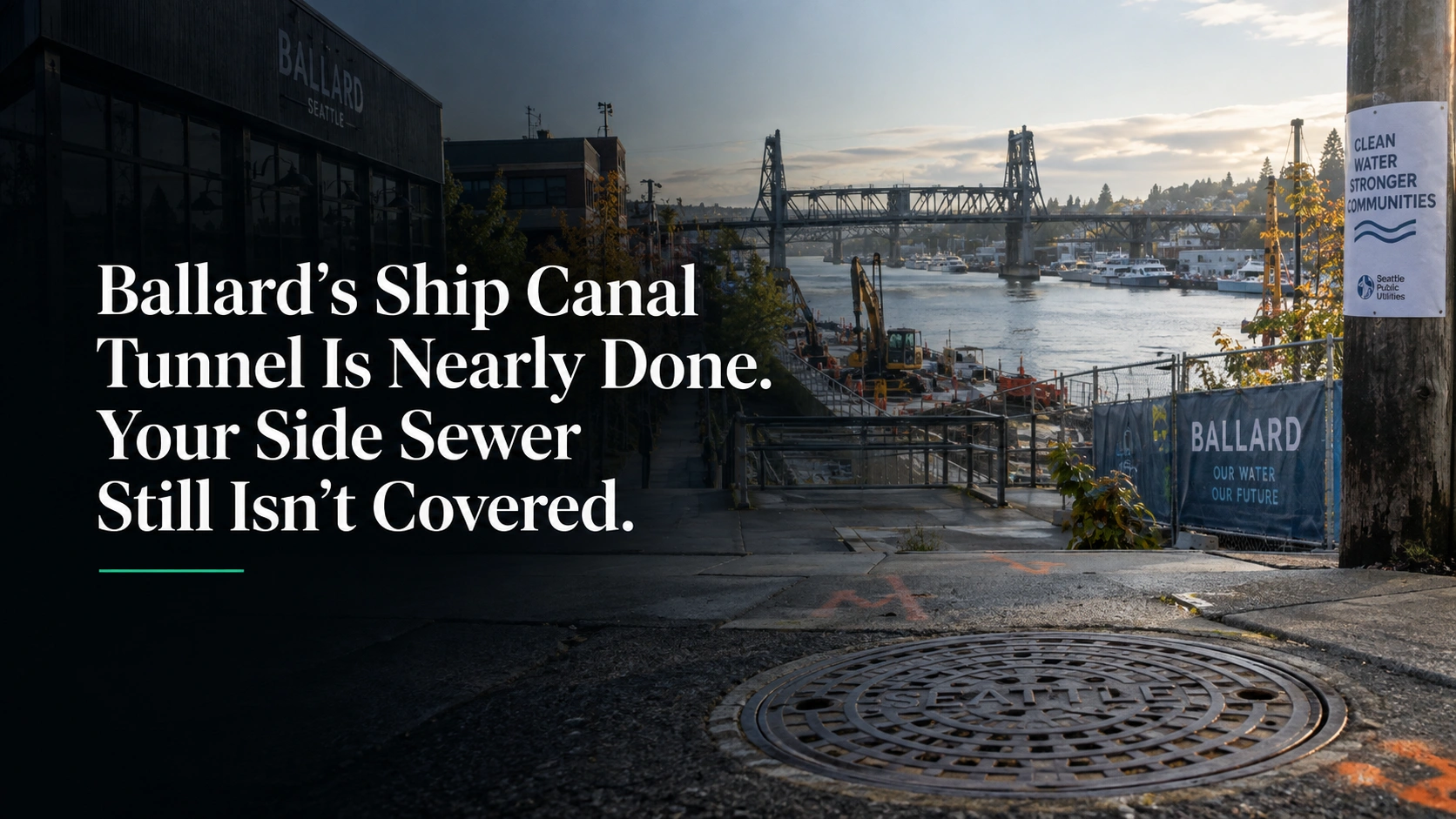
Ballard’s Ship Canal Tunnel Is Nearly Done. Your Side Sewer Still Isn’t Covered.
September 7th, 2026
Ballard · Infrastructure
BALLARD, SEATTLE, WA — September 8, 2026
By The Drain Authority | Reviewed by Shane Caldwell, Owner & Lead Drain Technician | WA Contractor Reg. #DRAINDA756MA
A tunnel boring machine is grinding west beneath NW 56th Street right now, closing out the last stretch of the largest sewer project in Ballard’s history. When it is finished, 29 million gallons of storage will sit under the neighborhood and combined sewer overflows into Salmon Bay should drop from roughly 130 a year to about one. None of it will do a thing for the pipe running from your house to the street — and in Ballard, that pipe is usually the one that fails.
What is happening under 56th Street right now
On September 3, My Ballard reported that Seattle Public Utilities has the tunnel boring machine moving west from the construction site at 24th Ave NW and NW 56th St, with crews expecting it to reach the intersection of 28th Ave NW and NW 56th St before the end of the year. That is the final stretch of tunneling on the Ship Canal Water Quality Project.
Tunneling is not the whole job. SPU’s own project page shows crews at the Ballard Pump Station still pouring concrete floors and walls to build out the required pump station levels, plus utility work along Shilshole Ave NW and 24th Ave NW to prepare for the pump station discharge pipe — some of it at night. Shaft construction and traffic control at 24th Ave NW and NW 56th St are scheduled to stay in place until spring 2027.
The practical translation for anyone living between Salmon Bay and Fremont: the hole is nearly done, the machinery that makes the hole useful is not.
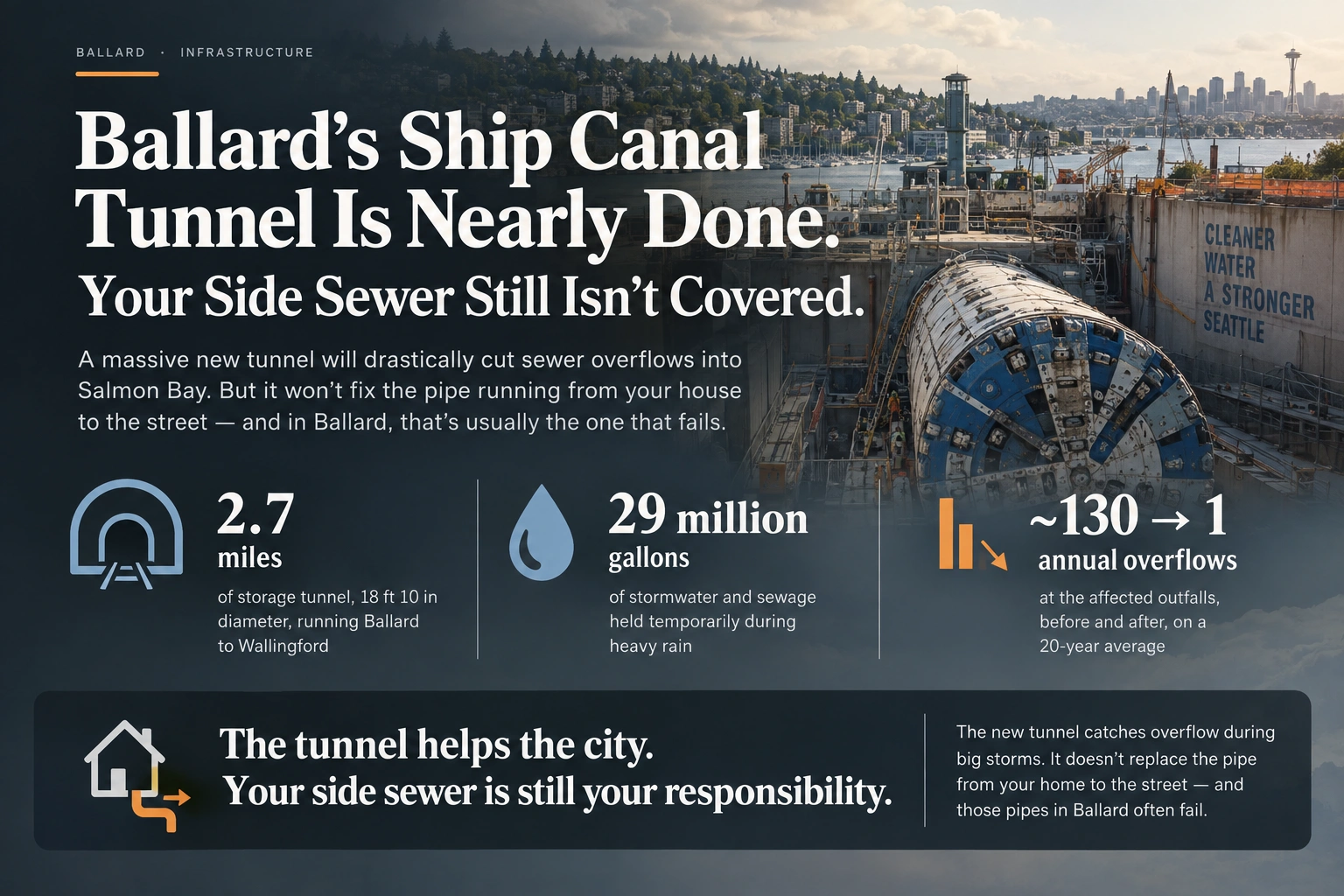
The Ship Canal tunnel adds 29 million gallons of public storage. The private side sewer from house to street is unchanged. Credit: The Drain Authority — free to republish with attribution and a link.
What the tunnel actually does
Ballard, Fremont, Wallingford and north Queen Anne sit on a combined sewer — one set of pipes carrying both sewage and street runoff. In dry weather everything goes to King County’s West Point Treatment Plant in Magnolia. In a hard rain, the pipes fill past capacity and the system dumps the mix through outfalls into the Ship Canal, Salmon Bay and Lake Union rather than backing it up into streets and buildings. Roughly 90% of that discharge is stormwater and about 10% is sewage.
The tunnel is a buffer. Running 2.7 miles from Ballard to Wallingford at an internal diameter of 18 feet 10 inches, it catches the surge, holds more than 29 million gallons of it, and pumps the flow to West Point once the storm passes. The project is being delivered under a federal consent decree between Seattle Public Utilities and King County, and the EPA’s WIFIA program describes the design target as reducing overflows to an average of one per year or fewer at all six CSO outfalls.
That is a genuinely large environmental win for Salmon Bay. It is also, from a homeowner’s perspective, entirely a public-side fix.
The angle most coverage is missing
The tunnel stops at the property line
Every story about the Ship Canal project describes gallons captured and overflows prevented. None of them mention the part of the system the public agencies do not own, do not clean, and will not repair: the side sewer.
In Seattle, the private side sewer runs from the building all the way to the connection at the public main — frequently under the sidewalk and out into the street. Seattle Public Utilities is explicit that maintenance and repair of that entire run is the property owner’s responsibility. A 29-million-gallon tunnel adds capacity to the city’s pipe. It adds nothing to yours. If your lateral is root-bound or belly-sagged, the storm that used to overflow the outfall now backs up somewhere closer to home.
Why Ballard’s laterals are the weak link
The Ship Canal project exists because the neighborhoods it serves were plumbed a long time ago. The same fact governs what is buried in the yards above the tunnel. Ballard’s housing stock is heavily pre-war and mid-century, and side sewers of that era are typically vitrified clay in short sections with mortared or gasketed joints — joints that separate as soil moves and that fine tree roots find easily.
The failure sequence is predictable. Roots enter at a joint. They form a mat that catches paper and grease. Flow slows. Standing wastewater accelerates corrosion and settlement at the same spot. By the time a homeowner notices a slow tub or a gurgling toilet, the restriction has usually been building for a season or more. Our field notes on tree root intrusion in Seattle sewer lines and on drain problems specific to older Seattle homes cover the pattern in more detail.
We mapped this neighborhood specifically in the Ballard Side Sewer Report, which looks at pipe material and installation era block by block across the same footprint the tunnel runs beneath.
This winter is still an unprotected winter
With the pump station still under construction and shaft work scheduled through spring 2027, the storage tunnel is not carrying wet-weather flow yet. The combined system in Ballard will handle the 2026–27 rainy season the same way it handled the last one.
That matters for timing. Side sewer failures in this part of the city cluster in the first sustained wet stretch of the fall, when groundwater rises, soil swells around old joints, and a line that was marginal in August stops passing flow in October. SPU publishes wet weather preparation guidance and a separate page on what to do when a side sewer backs up, both worth reading before the first atmospheric river rather than during it.
Expert commentary
“People hear about a project this size and assume the whole system got upgraded. It didn’t. The city rebuilt its half. Your half is the same clay pipe it’s been since the house went up, and it’s the half that puts water on your basement floor. The tunnel is a real accomplishment — it just isn’t a reason to skip a camera inspection before the rain starts.”
— Shane Caldwell, Owner, The Drain Authority, Ballard
What Ballard property owners should do before the rain
Pull your side sewer card. Seattle keeps historic side sewer permit drawings for most properties. They show the original route, material and connection point — the starting information any honest diagnosis begins with.
Scope the line, don’t guess at it. A sewer camera inspection in Ballard shows joint separation, root mass, bellies and grade before any of it becomes a Saturday-night emergency. Ask for the footage, not a verbal summary.
Cut roots properly, then clean the wall. Cabling opens a channel through a root mat; it leaves the mat. Hydro jetting in Ballard restores the full pipe diameter, which is what actually buys you a season.
Know where your shared lateral runs. Older Ballard blocks frequently have two or more houses tied into one private run. Responsibility for that arrangement is a legal question as much as a plumbing one, and it is far cheaper to answer it in September than in a January backup.
Verify whoever you hire. Check the contractor registration and bond status on the Washington L&I verification portal before work starts. It takes about a minute.
Get your Ballard side sewer scoped before the first storm
The Drain Authority is based at 5608 17th Ave NW, Suite 2025 — four blocks from the tunnel alignment. Camera inspection, root cutting and hydro jetting for King and Snohomish counties.
Will the Ship Canal tunnel stop my basement from backing up?
No. The tunnel adds 29 million gallons of storage to the public combined sewer to reduce overflows into the Ship Canal, Salmon Bay and Lake Union. In Seattle, the side sewer running from your building to the connection at the public main is the property owner’s responsibility to maintain and repair, and a backup caused by roots or a collapsed joint in that private run is unaffected by the tunnel.
Is the tunnel finished?
Tunneling is in its final stretch. SPU has the boring machine moving west from 24th Ave NW and NW 56th St and expects it to reach 28th Ave NW and NW 56th St later this year. The Ballard Pump Station is still being built — crews are pouring concrete floors and walls — and shaft construction and traffic control at 24th Ave NW and NW 56th St are scheduled to remain in place until spring 2027.
How many combined sewer overflows does Ballard get now?
The affected outfalls serving Ballard, Fremont, Wallingford and north Queen Anne currently average roughly 130 overflows a year. The Ship Canal Water Quality Project is designed to bring that down to an average of one per outfall per year or fewer, measured on a 20-year moving average.
What is actually in a combined sewer overflow?
In Seattle’s combined system, sewage and street runoff share one set of pipes. When capacity is exceeded during heavy rain, the discharge sent to the outfalls is roughly 90% stormwater and about 10% sewage.
When is the best time to have a Ballard side sewer inspected?
Before the first sustained wet stretch of the fall. Failures in older Ballard laterals cluster once groundwater rises and soil swells around aged clay joints, which is when a line that passed flow in August stops passing it in October. With the tunnel not yet carrying wet-weather flow, the 2026–27 season runs on the existing system.