
Seattle Sewer & Utility News
Seattle, WA — August 16, 2026 | By The Drain Authority
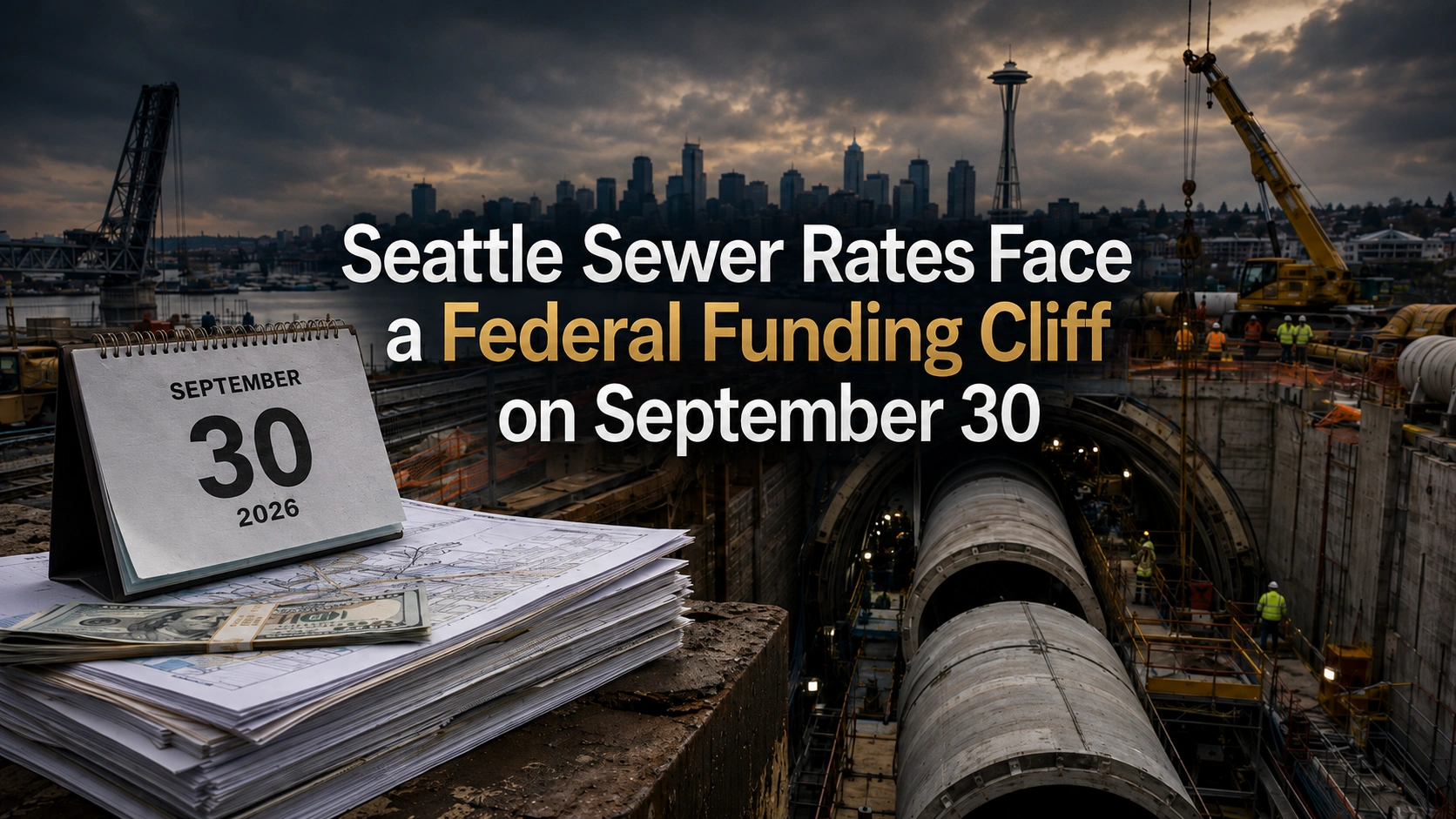
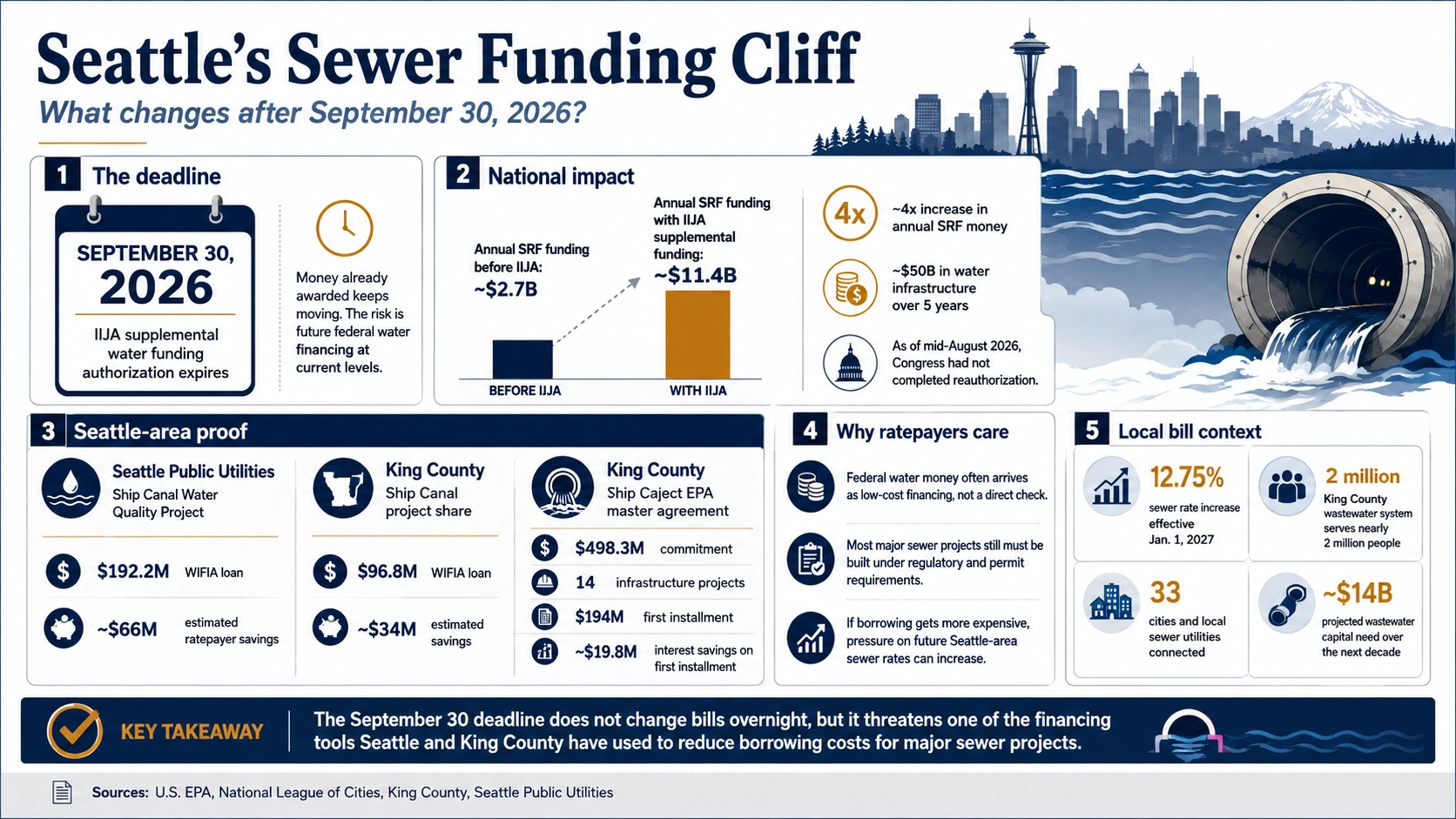
On September 30, the federal law that has quietly been holding down the cost of Seattle-area sewer construction expires. The Infrastructure Investment and Jobs Act’s supplemental water funding runs out that day, and Congress has not yet reauthorized the programs behind it. For homeowners in Seattle, Shoreline, Lynnwood, Bothell, Renton and the rest of the region, this is not an abstraction in Washington, D.C. — it is the financing structure underneath the 12.75% sewer rate increase that already takes effect on January 1, and underneath the projections for every year after that.
The 2021 infrastructure law put roughly $50 billion into water infrastructure over five years, split across five funding streams under the Clean Water State Revolving Fund and the Drinking Water State Revolving Fund. It was written as a supplement to normal appropriations, not a replacement for them, and according to the National League of Cities, it roughly quadrupled annual State Revolving Fund money — from about $2.7 billion a year before the law to roughly $11.4 billion a year while it has been in effect.
Money already awarded to communities is still moving. The EPA announced $7.2 billion in State Revolving Fund allotments for the current fiscal year, drawn from both annual appropriations and the infrastructure law. What expires on September 30 is the authorization — the legal ceiling that lets Congress keep appropriating at that level. Without a reauthorization, the baseline reverts toward where it sat before 2021.
Local governments have been raising the alarm for months. Construction Dive reported in June that cities and water stakeholders were pressing Congress to reauthorize the core programs and fully fund water infrastructure in fiscal year 2027 before the deadline arrives.
This is the part that never makes the local coverage. Seattle Public Utilities and King County have been two of the more aggressive users of federal low-cost water financing in the country, and the savings were passed to ratepayers as avoided interest.
The clearest example is the Ship Canal Water Quality Project — the storage tunnel running under Ballard, Fremont, Wallingford and north Queen Anne. According to the EPA’s project page, SPU borrowed $192.2 million through the Water Infrastructure Finance and Innovation Act against $561.2 million in eligible construction costs, and the agency estimates that financing it this way rather than issuing bonds saved Seattle ratepayers about $66 million. King County borrowed separately for its share of the same tunnel; the EPA’s fact sheet on that loan puts the county’s borrowing at $96.8 million and its estimated savings at roughly $34 million.
| Project / borrower | Federal financing | Reported ratepayer savings |
|---|---|---|
| Ship Canal Water Quality Project — Seattle Public Utilities | $192.2M WIFIA loan | ~$66M vs. bond issuance |
| Ship Canal Water Quality Project — King County share | $96.8M WIFIA loan | ~$34M |
| Georgetown Wet Weather Treatment Station — King County | $134.5M WIFIA loan (2018) | Not separately reported |
| 14-project master agreement — King County | $498.3M commitment; $194M first installment | $19.8M interest on first installment |
| State Revolving Fund borrowing, past decade — King County | Multiple low-interest loans | $162M |
Figures as reported by the EPA and King County at the time each loan closed. They span different years and are not additive.
The master agreement is the largest of the group. King County announced in 2024 that it had secured a $498.3 million EPA loan package covering 14 infrastructure projects — seismic upgrades at two regional treatment plants, recycled water improvements, and miles of conveyance and sewer pipe replacement. The named projects read like a map of the Eastside: rehabilitation of the Eastside Interceptor in Bellevue, 4.5 miles of new sewer pipe serving Bellevue and Redmond, added capacity for the East Lake Sammamish area, raw sewage pump replacement at West Point in Magnolia, and seismic upgrades to the influent pump station at the South Treatment Plant in Renton. The first $194 million installment alone was projected to save ratepayers $19.8 million in interest. Wastewater Treatment Division Director Kamuron Gurol said at the time that the county needed the federal package so “our ratepayers aren’t left alone to shoulder the burden.”
Federal water money in this region does not arrive as a check. It arrives as cheap debt. The projects get built either way — a federal consent decree and a state discharge permit make most of them non-optional — so the only real variable is the interest rate the region borrows at, and who ultimately pays the difference.
That variable is not small. King County’s Wastewater Treatment Division serves nearly two million people and sells wholesale treatment to 33 cities and local sewer utilities across King, Snohomish and Pierce counties. Whatever it pays to borrow gets spread across that entire base, which is why a financing decision made in a federal loan office ends up on a utility bill in Kenmore or Mountlake Terrace.
The scale of what still has to be built is the other half of the equation. In its April rate proposal, the division put the cost of the next decade at an estimated $14 billion, with about $7 billion of that — roughly half — driven by state and federal regulatory compliance. The consent decree King County signed with the state Department of Ecology and the EPA requires further reductions in combined sewer overflows by 2037. That deadline does not move if the financing gets more expensive.
There has been movement, though not yet a resolution. The National League of Cities reported on July 28 that two committees advanced water bills in mid-July: the House Transportation and Infrastructure Committee unanimously approved its Water Resources Development Act on July 14, and the Senate Environment and Public Works Committee unanimously passed its version on July 15.
The important difference is that only the Senate bill carries language reauthorizing the EPA drinking water, wastewater and stormwater programs — including a Clean Water State Revolving Fund authorization of $3.5 billion and $65 million for the WIFIA program that financed the Ship Canal tunnel. Whether that language survives conference negotiations with the House is genuinely unsettled. Neither House committee with jurisdiction over those EPA programs has produced its own reauthorization bill, which makes conferencing those provisions harder, not easier.
Reauthorization is also only the first step. Setting an authorization ceiling does not appropriate a dollar; Congress still has to fund the programs annually against that ceiling, and the administration’s fiscal 2027 budget request proposed cutting the two State Revolving Funds from about $2.7 billion to $305 million — a reduction of roughly 90% — along with a proposed cut to WIFIA down to $8 million in administrative funding.
National coverage of the September 30 deadline treats it as a budget story. Local coverage of the 12.75% rate increase treats it as a King County story. Nobody has connected the two, and the connection is in King County’s own paperwork.
When the county transmitted the 2027 rate proposal in April, it listed five specific actions to promote long-term affordability. One of them was to keep reducing ratepayer costs by “successfully competing for low-interest loans and loan flexibility offered by state and federal agencies.” That is not a footnote. It is one of five named levers the county says it will pull to slow the rate curve — and the same document notes that state revolving fund borrowing alone has saved ratepayers $162 million over the past decade.
So one of the five affordability levers in the county’s plan depends on a federal program whose authorization expires in six weeks, with reauthorization language sitting in one chamber’s bill and not the other’s. That does not mean rates jump on October 1 — existing loans are already closed at their original terms, and awarded money keeps flowing. It means the assumption baked into the out-years is now an open question. The published forecast has the wholesale monthly rate climbing from $70.65 in 2027 toward roughly $125.92 by 2032. That path was drawn assuming the region keeps winning cheap federal credit.
The short version: the projects are mandatory, the deadlines are fixed, and the only thing genuinely in play is the interest rate. When public financing gets more expensive, ratepayers absorb the difference — and none of it touches the pipe running from your house to the street.
Every dollar described above pays for public infrastructure: treatment plants, trunk lines, pump stations, overflow control. None of it pays for the side sewer — the privately owned line running from your foundation to the public main. In Seattle and across the surrounding cities, that line is the property owner’s responsibility from the house all the way to the connection at the main, and it always has been.
That division of responsibility is the whole practical point. The regional portion of your bill is on a documented upward path with roughly $14 billion of mandatory work behind it, and now a financing question layered on top. The private portion is the one place a homeowner has any leverage at all. We looked at what the city’s own permit records show about the age and material of those private lines across North Seattle in the Ballard Side Sewer Report, and the pattern holds across most of the older housing stock in the region — clay and cast iron installed decades before anyone was budgeting for its replacement.
A camera inspection is the cheapest way to find out which category your line falls into. A sewer camera inspection in Seattle tells you whether you are looking at routine buildup, root intrusion, a bellied section, or a line that is genuinely near the end. If the problem turns out to be the main line rather than a branch, main sewer line cleaning in Seattle is a scheduled job at a known price — which is a different financial event than paying emergency rates on a Saturday. It is also worth knowing how the $99 drain cleaning offers in this market actually work before a rising utility bill pushes you toward the cheapest number you can find.
The same math applies across the region, because these cities sit inside the same treatment system and the same rate structure: Ballard, Shoreline, Lynnwood, Edmonds, Bothell, and Kirkland.
If you want the full picture of how drain and sewer work is priced and scoped in this market before you call anyone, our Seattle drain cleaning guide walks through it. You can also browse our full range of Seattle drain and sewer services or check the cities we cover across King and Snohomish County.
September 30 is not a date that will produce a dramatic headline in Seattle. Nothing shuts off, no rate changes overnight, and the 12.75% increase already approved for 2027 is locked in either way. What happens is quieter: the region’s largest wastewater utility loses certainty about one of the five tools it has publicly named for keeping rates down, at the exact moment it is starting a $14 billion decade.
If Congress reauthorizes the programs at or near current levels, the forecast the county published holds roughly as written. If it does not, the borrowing gets more expensive and that cost lands where it always lands. Either way, the pipe under your yard is still yours.
No. Nothing changes on your bill that day. September 30 is when the authorization for the federal water infrastructure programs created by the 2021 infrastructure law expires. The separate 12.75% King County increase already approved takes effect January 1, 2027, and is unaffected by the deadline.
Seattle Public Utilities borrowed $192.2 million through the federal WIFIA program for the Ship Canal Water Quality Project, which the EPA says saved ratepayers about $66 million compared with issuing bonds. King County borrowed $96.8 million for its share of the same tunnel, $134.5 million for the Georgetown Wet Weather Treatment Station in 2018, and secured a $498.3 million EPA loan package covering 14 projects in 2024.
Not as of mid-August 2026. The House Transportation and Infrastructure Committee approved its Water Resources Development Act on July 14 and the Senate Environment and Public Works Committee passed its version on July 15, but only the Senate bill contains language reauthorizing the EPA water programs. Those provisions still have to survive conference negotiations between the two chambers.
No. All of it funds public infrastructure — treatment plants, trunk lines, pump stations and overflow control. The side sewer running from your home to the public main is privately owned and remains the property owner’s responsibility, from the house all the way to the connection at the main.
The Wastewater Treatment Division estimates $14 billion is required to meet state and federal regulatory deadlines, modernize infrastructure that has run nearly nonstop since the 1960s, and add capacity for a growing population. About $7 billion of that — roughly half — is driven by regulatory compliance, including a consent decree with the Department of Ecology and the EPA requiring further combined sewer overflow reductions by 2037.
Sources: National League of Cities — What Congress Needs to Advance on Water Infrastructure (May 15, 2026); National League of Cities — What Local Leaders Need to Know about Congressional Water Legislation (July 28, 2026); U.S. EPA — Seattle Ship Canal Water Quality Project (WIFIA); U.S. EPA — King County Ship Canal WIFIA loan fact sheet (PDF); U.S. EPA — Drinking Water State Revolving Fund; King County — $500 million EPA commitment for wastewater investments; King County DNRP Field Notes — 2027 sewer rate proposal (April 23, 2026); King County — Sewer rate and capacity charge; Construction Dive — Cities push Congress to avert water infrastructure funding cliff.
Drain backed up? Get a flat price before we start.
Same-day service when the schedule allows. No trip fee to look. Open daily, 8 AM to 8 PM.

The Drain Authority is a Seattle drain and sewer cleaning company based in Ballard, serving homes and businesses across King and Snohomish counties.
5608 17th Ave NW, Suite 2025Recent Drain & Sewer Work
Real jobs from Seattle, Bellevue and Renton: roots, grease, scale, floor drains and sewer camera inspections.
Compare drain and sewer services© 2026 The Drain Authority LLC. All rights reserved. Powered by PSC


